While the 33-piece Invention Piece 1 layered a time display atop Greubel Forsey’s first innovation – the Double Tourbillon 30º – the Invention Piece 2 built on the brand’s second key development from 2008 – the Quadruple Tourbillon a Differentiel.
The difference
The Invention Pieces were to be the ultimate iteration of the brand’s already maximalist approach to engineering and craft. Even within the small series of 22 pieces that the Invention Piece 2 was created in between 2011 and 2012, this particular example stands singular. It was born of one collector’s desire for a unique execution of the Invention Piece 2’s aesthetic, and later refined by a subsequent collector’s exacting standards of movement finishing. Consequently, this Invention Piece 2 wears the seldomseen “Exécution spéciale” designation.
In its standard guise, the Invention Piece 2 reimagines the architecture of the innovation first seen in the serially produced 2008 Quadruple Tourbillon reference. It maximises the remarkable quad-tourbillon setup. The two double tourbillons – with a one-minute carriage, inclined at 30º and set within a slower, four-minute rotating carriage – are arranged across from each other, linked by a differential that uses the aggregate of their rates to drive the gear train. The innovation is predicated on multiplying the effect of the tourbillon in fighting the effects of positional errors on balance amplitude and linear chronometry.
This architectural departure from the standard Quadruple Tourbillon is paired with a refreshed time display. Located between 3 and 6 o’clock, it features a transparent triangular sapphire hours indicator and a wandering minutes window.
While there is a subsidiary seconds indication, this is in addition to the one layered atop the four-minute outer tourbillon just above the time display. This is a ‘seconde sectorielle’ display with a four-pointed, four-minute sapphire disk divided into minute-long sectors – a slim sapphire pointer serves to mark the passage of seconds. It is a concept that is better viewed than explained and this is at the heart of the aesthetic of the Invention Piece 2.
Precursor to the aesthetic code
As noted earlier, this watch features several refinements over the 21 other examples of the Invention Piece 2 series. On special request, the time display is adorned with a micro-decoration that became the brand’s aesthetic code starting with the Invention Piece 3. The text reveals itself upon closer inspection – it details the Greubel Forsey invention at the heart of the watch as well as the brand’s credo. Other engravings note the name of the watch as well as the fact that this piece is indeed unique. The time scale features a quarter of luminous Arabic markers with hashes for the rest of the hours.
Another detail unique to this piece is the finishing on the dial-side tourbillon bridges. These feature sharper interior angles than on the standard production watch, done at the behest of an exacting previous owner. The bridges are black polished, with wide angled edges that have been mirror polished. The one-minute carriages are finely decorated, while the four-minute carriage wears the coupled serial numbers for the two tourbillon stacks.
Understandably, in order to accommodate the incline of the tourbillons the dial has considerable depth. The baseplate, which lies far below the time display, is frosted. It is home to the sector-style seconds display as well as the 56-hour power reserve register. The airiness of the tourbillon silos lighten the both the dial- and movement-side views of the Invention Piece 2.
The case
The platinum case measures 43.5mm across, notwithstanding the prominent bulge at 7 o’clock, and its less pronounced counterpart at 1 o’clock. The mirror-polished bezel follows this irregular form of the case, as does the sapphire crystal. The bezel has a flat facet where it meets the gently rounded, vertically satinated form of the midcase. Interestingly, housed in the bulge in the midcase at 7 o’clock is a crystal aperture that offers a profile view of the double tourbillon located there.
The case that stands 16mm tall is rich with details and finishing. From the satinated midcase originate the robust lugs. These feature a gentle concave camber. The lugs are polished, standing them apart from the rest of the midcase. The crown is large and knurled and the engraved brand mark here is filled with black lacquer. The caseback is thoughtfully formed to minimise both the thickness and the footprint the watch occupies on the wrist – it features a sunken base engraved with the brand mark on a frosted base, hand-engraved serial number and precious metal hallmarks. In addition, this portion is engraved with “Exécution spéciale” owing to the special finish and decoration lavished on this particular example.
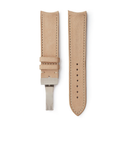
The 22mm lug width is furnished with a curved end black sailcloth strap, bolstered with alcantara. It is secured by a solid platinum pin buckle, with a hand-engraved brand mark. The watch comes with an additional, large-grained black leather strap.
Movement
Further in from the caseback bezel is a raised portion that frames the irregular sapphire crystal. Contained within it is a view of the manually wound calibre. While it is a vessel for the brand’s second key innovation, it was in fact extensively reworked to highlight the architecture of the Quadruple Tourbillon a Differentiel.
The view is dominated by two bridges adjoining the two tourbillons. The bridges are frosted and feature relief micro-engraving with a message from the brand as well as details of the Quadruple Tourbillon a Differentiel innovation. At the centre, capping the differential, is a plate engraved with the serial number out of 11.
The finish on the tourbillon bridges on the movement side has also been upgraded. The interior angles are sharper than on standard variants of the Invention Piece 2.
In context
The Invention Piece watches were conceived as maximalist iterations of the brand’s key innovations. That this example has been extrapolated further, both in terms of decoration and finishing, establishes this Invention Piece 2 as one of the finest Greubel Forsey watches ever created.
If sold within the United Kingdom, this Greubel Forsey Invention Piece 2 will be subject to 20% VAT