





































An Afternoon with Dann Phimphrachanh
Kwan Ann Tan
We arrive in Saint-Blaise, a small village located at the foot of the Chaumont Peak and part of the picturesque and well-known canton of Neuchatel, on a breezy spring day. Dann Phimphrachanh’s workshop is tucked into a maze of small roads, and when the door swings open, he apologises to us — he is in the middle of finishing a dial and has to keep working, or the metal will oxidise.
The workshop is beautifully lit, and has a simple, almost ascetic appearance. Apart from a few personal touches, this is a workspace centred on clarity and focus, in keeping with Phimphrachanh’s own approach to watchmaking. A soft-spoken and incredibly eloquent individual, the watchmaker has a real sense of calm earnestness about him as he strives to work towards a vision he has honed over the years.


Phimphrachanh at his workshop in Saint-Blaise.
“The thing is, there can be no compromise. You need to be strict with yourself. But when you know it’s right, you don’t have any doubt. It just fits.”
Phimphrachanh has Laotian heritage and was born in France, into a military family. He spent a large part of his childhood in Lisbon, attending vocational school and college there. Sitting at his bench with the radio going in the background, he peers down at the dial he’s working on while talking to us — multitasking with impressive skill. He starts his story at the very beginning, telling us about his earliest foray into watchmaking, when he was just 14 years old.
“It wasn’t watchmaking itself that made me interested in the work,” Phimphrachanh shares. “For so many people, it’s a watch or something similar that brings them into the work. Usually, when you look for a job, you are seeking something that’s useful.”
The pivotal moment that led him to watchmaking was on a school visit, when he witnessed two students creating a piece of art that impressed him.
“They were designing something of their own, with no purpose of production. It was like a drawing for a kid — a free-spirited thing. I think it was good for me,” he muses.


The workshop is fairly large given that Phimphrachanh is the only watchmaker, but feels very peaceful and quiet.
His watchmaking career includes some illustrious names, as he first started working at Parmigiani Fleurier in 2007, dealing with vintage timepieces. Just a few years later, his work with complicated pieces began, as he moved to Greubel Forsey in 2011. In 2013, he worked at Bulgari, part of a team that had to figure out how to shape the future of Daniel Roth’s watches after Roth’s departure, and his final shift was to Jaeger-LeCoultre, working there between the years of 2015 to 2017.
Phimphrachanh finally began working under his own name in 2018. He says, “I made the step to be independent when I was sure that I was not learning a lot or enough in the industry. I always wanted to be independent.”
It’s clear that there are complicated feelings around the current state of watchmaking as an industry, balanced by his optimism about independent watchmaking. Over the course of our conversation, Phimphrachanh speaks about the industry with a critical eye, acknowledging how much it has taught him while also relaying the sense of frustration that led him to set up his own workshop in the first place. Crucially, it’s that connection between the watchmaker and the collector that Phimphrachanh strives towards.


Every component in Phimphrachanh’s watch was created by hand.
When asked about where this desire for connection began in the first place, Phimphrachanh shares a story about his time in Portugal, working at a watch shop for a few years. “When you have contact with real people, people who are willing to buy a watch, the connection gives you just one thing, and that is we are all very simple,” he says. “When a guy comes to a shop to buy a watch, he wants to find something that gives him pleasure. He goes inside, he sees the watch, he touches it, compares the watches, and then he puts it on the wrist. It’s different with everybody, but you can almost feel if he’s seduced by the watch or not. Through his eyes, or the way he’s looking at the watch, you can feel if he likes the watch or not.
“In the industry, for the watchmaker and the people that are not selling watches, we do not have this kind of contact with the people. Everything, all the language, all the decisions made, all the work you are doing, they are based in some Excel sheet. So, you lose a lot of connection to the final person buying the watch.”
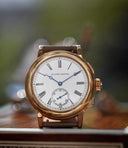
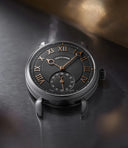
The spirit of connection between watchmaker and collector was a significant factor in the creation of his first watch, the Seconde Vive – loosely translated to “lively seconds”. With this timepiece, Phimphrachanh challenged himself to create something that could bring the collector into the world of the watch, something that had a beautiful visual translation of its complex mechanics. A secondary consideration was that it had to be a piece that would earn him recognition among his peers, combining this hunger for legitimacy with the desire to create something that looked and felt as if it were truly alive.


Phimphrachanh’s nearly 20 years in the watchmaking industry, both within it and as an independent has shaped his perspective on how things should be done.
“For the Seconde Vive, I needed something that was small enough to be on the wrist and make it comfortable, but yet big enough for you to understand everything inside it,” he tells us. “Everything was fitted inside two springs that I had. I have the spring of the barrel and the spring of the balance and between them I managed to link those two springs, and that gives you the train wheel. With the train wheel, you can see that you don’t need a loupe to understand that it’s a wheel. You don’t need a loupe to see the anglage and the definition of it.”
Phimphrachanh explains that the mechanical workings of the watch comes before its overall design, as he works from the inside out. He says, “The mechanical part was the first thing that I fixed. Then I put every wheel in the place that it needed to be, and after that I took a piece of blank paper and designed every curve of every bridge, then the dial, then the case, as fluidly as possible.”
Finishing up his work at the bench, he tells us that he created almost seven different designs for as many different mechanisms. Each of these were created in the metal, because only after seeing them in person could he tell whether or not they would be good enough to keep. According to Phimphrachanh, “The thing is, there can be no compromise. You need to be strict with yourself. But when you know it’s right, you don’t have any doubt. It just fits.”


Every component in Phimphrachanh’s watch was created by hand.
Another crucial part of Phimphrachanh’s process is that he makes and finishes each component of his watch entirely by hand. This is a belief that he holds very strongly, saying, “Every time we speak with someone that is dreaming about watchmaking, or speaking to a collector who is willing to find something that really fits in our mind about watchmaking, we think about something that is handmade.”
His experiences in the industry have shaped this view, especially as someone intimately familiar with what goes on within the brands. “When I discovered watchmaking, when I really discovered watchmaking – what we understand about watchmaking, what is savoir-faire, what is metier d’art – [I realised] those things are around every brand, almost all of them. Even if it’s not written, it’s supposed to be,” he says. “At the time, my impression was that those were somewhat empty words and the commercial parts took the name ‘manufacture’. This word, ‘manufacture’, was not an English word – it was a Latin word.
“Not just through handmade finishing and not just the final operations being handmade but doing every part by hand. The thing is, for me, we have a responsibility, because people trust us. If you trust someone and he’s telling you or bringing you something he calls traditional watchmaking, or artisanal watchmaking, it’s important that you do not lose this trust that people have in you, you have to make your words, or your acts fit together. This is my responsibility as a watchmaker — speaking about traditional watchmaking and giving the idea of tradition to the collector. And in a more personal approach, doing things by hand. I think it’s the only way to make good things. There is no other way.”

The connection between the watchmaker and the metal they work with is a core aspect of Phimphrachanh’s own experiences and one he feels extremely passionate about. When looking at the Seconde Vive, this feeling is almost visible in how all the elements come together, and in how the different textures blend and contrast.
“I don’t think there’s another way to be able to approach my art,” Phimphrachanh admits. “You need to try, to understand. You need to fail; you need to find solutions. It’s a part of the apprenticeship. Mastering watchmaking is like learning a language. People say you need at least 15 years in a watchmaking position before you fully start to master it. I think it’s true. You need time and experience, you need this feedback between your movement and the material, and for me, that’s the best way to do it.”
"If you trust someone and he’s telling you or bringing you something he calls traditional watchmaking, it’s important that you do not lose this trust that people have in you. [...] This is my responsibility as a watchmaker — speaking about traditional watchmaking and giving the idea of tradition to the collector."


Old school approaches: a notebook and pen contains many of Phimphrachanh’s thoughts on creation and process.
His process of physical creation and being in tune with his creation is also supplemented by a strict mental regimen of journalling, a process that helps him work through his craft. To him, this is especially important, given that he works alone and does not have anyone to discuss things with or bounce ideas off. More importantly, he mentions that it helps him slow things down.
“I needed to do this alone, because I needed to prove to my self that I am capable of doing this,” he says. “[Journalling] is the best way to understand what I am going through or what feelings I’m having inside the workshop. Sometimes it helps you de-zoom the problems or even the joys, but it’s a part of knowing myself and helps me the next day to have the clearest mind.”
The personal aspect of this practice aside, he shares that it has also helped greatly when it comes to figuring out mechanical problems: “It’s interesting that writing helps you bring something closer to reality. You can imagine a lot of procedures in making spare parts, and even when writing them, sometimes in the middle of writing something down, I understand that it’s non-viable, but I just needed to go to the end and fix it on paper.”


Different ideas of how one should live, united across time and geographical location in philosophies across the ages.
It’s perhaps unsurprising that Phimphrachanh’s collection of books in his workshop consists of philosophical and spiritual texts ranging from Buddhist sutras to the writings of Marcus Aurelius and Seneca, all suggesting a rich historical and spiritual world from which he draws inspiration and rules for life.
His interest in these ancient texts is in keeping with the makers he admires, largely from the golden age of watchmaking – John Harrison, George Daniels and Derek Pratt, to name a few. When it comes to independent makers, Phimphrachanh mentions Francois-Paul Journe several times, both in terms of design and construction. “I think [Journe’s] watches are just wonderful, and when it comes to the way of doing watchmaking and bringing watchmaking to the world, I really like [Kari] Voutilainen. From smaller independents, of course, all of them, but just from the generation before, Daniel Roth – I really admire him and his path, the way he did watchmaking was really inspiring to me.”

When asked how he feels about the current state of watchmaking, and the independent movement that has only grown stronger over the past few years, Phimphrachanh spoke about his appreciation of the variety that is present today, and his sense of community: “I think to be an independent, it gives you a very vast view of watchmaking. Because you’re speaking with collectors, but also with suppliers, with other watchmakers that are working with you. It gives you some kind of possibility to be all in or to be complicit in what you are doing. It’s one of the reasons that makes us very close, because we kind of understand the struggles of everyone. It’s not a real family, but we understand the meaning of being independent in watchmaking.”


Textures of the town of Saint-Blaise.
“I needed to do this alone, because I needed to prove to my self that I am capable of doing this.”
But even as Phimphrachanh speaks with great admiration for the work that his peers are doing, he is still a traditionalist at heart, citing the fact that three biggest watchmaking inventions, in his view, are: the tourbillon, the perpetual calendar, and the minute repeater.
“I’m not looking to find the newest or the nicest thing, but there are complications that I want to make,” he says. “I don’t know in what order yet, but if I die having made those three complications, I think I would be happy with my watchmaking.”


Chasing in the footsteps of the great masters, Phimphrachanh’s dreams include the interpretation of historical complications.
Our thanks to Dann Phimphrachanh for welcoming us into his workshop. Film Director/DP: Neal Fagan.