











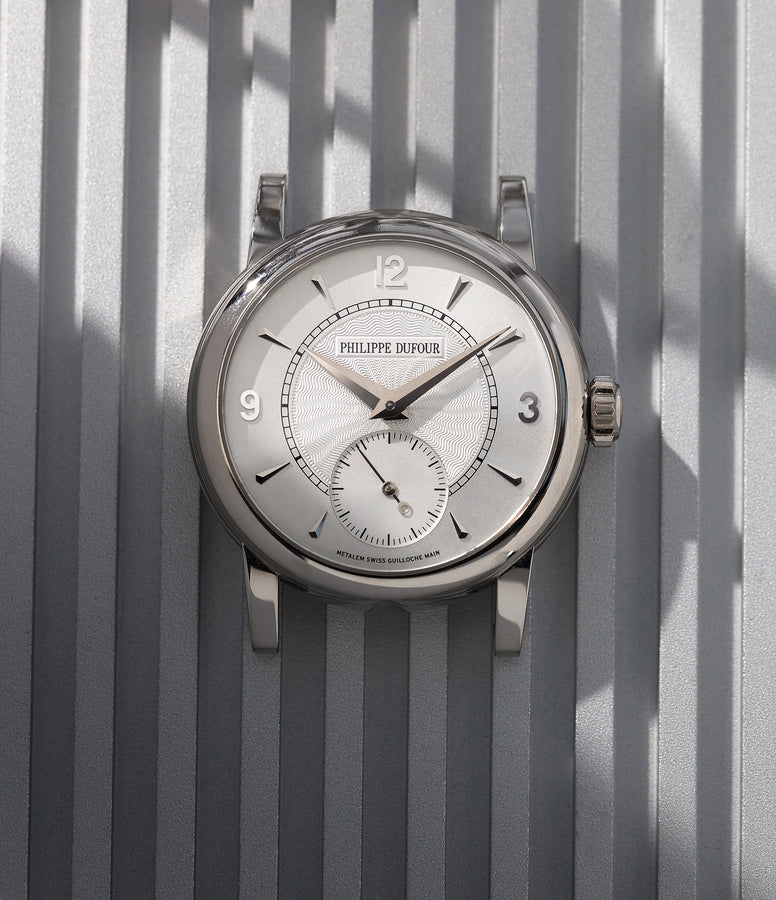





























In Practice: Enamel Dials at Émailleurs de la Cité
Kwan Ann Tan
Straddling the worlds of craft and art, enamel is often seen as separate to watchmaking – used to adorn dials and held in an exalted position that can elevate a piece but never quite reconciled with the mechanics and clockwork that underpin a watch.


Details from the workshop.
At Émailleurs de la Cité, the work of artisans is closely entwined with the watchmaking involved, working alongside, rather than in isolation. An enamelling workshop co-founded by Rexhep Rexhepi and Florent Olivier Martin, and located just a stone’s throw from the main watchmaking workshop in Geneva’s Old Town, the space is a rich seam of craft, with grand feu, cloisonne, pliage, grisaille among just a few of the techniques practiced here.
The Principles of Enamel
Enamel is a powdered glass, which can be mixed with metal oxides to provide a broad spectrum of base colours. There are several different types of enamel, including transparent, opaque, which can be further combined and mixed to create a specific shade.
This is complicated still by the type of metal the enamel is painted on, with each enameller relying on experience and a deep understanding of the material. Crucially, the shade may change yet again when fired, making even selecting a shade a difficult process, with variation possible at every step.

These are just basic considerations when working with enamel, and it would be impossible to document all the processes involved in the different techniques practiced at the workshop. Here, we focus on the enamel dials of the Chronomètre Contemporain II, which feature grand feu enamel, following the artisans as they create the dial step-by-step.
From Stone to Dial


A suspension of frit and water, which is ground to be perfectly even.
The Chronomètre Contemporain II’s dials come in two shades. One an ivory or eggshell white, and the other a deep, glossy black.
At the very beginning, the enamel frit, or granulated substance, is chosen. This is then ground with a mortar and pestle into a fine powder. Distilled water is kept at hand to wash the grains as the grinding happens, to remove any impurities and creating a suspension of enamel. This part of the process is repeated over and over until the artisan obtains the exact grain size, looking for uniform grain sizes to ensure an even effect when the dial is fired. When that is ready, the enamel is painted onto a coarse, unpolished dial base, which allows the enamel to cling on evenly.
“Across different dials there can be the slightest of variations, revealing the artist’s hand behind each step of the process.”

For the ivory dial, developing the exact shade desired required much trial and error, with it still proving a challenge to replicate accurately each time. Added to that is the individual touch of the enameller – for example, across different ivory dials there can be the slightest of variations, revealing the artist’s hand behind each step of the process.
Notably, while the surface of the black CC2’s dial appears to be a deep black, there is no true black enamel — it simply does not exist. Instead, the colour is derived from heavily saturated dark blue, green, or brown stones, with their liquid forms boiled up to 30 hours so the metal oxides can fully saturate the glass mass. To get a truly black dial, many layers of enamel are required, providing depth after being fired.
An Even Bake
After the dials are painted, they are placed in a vacuum furnace at a controlled temperature, with the vacuum also acting to prevent air bubbles that could mar the surface of the dial. The next step is a stint on the dehumidifier, and then a firing in the oven at an even temperature. The temperature itself is also an important part of determining the outcome of the dial colour, with different degrees for different shades.


Part of the firing station, the dial colours must be carefully monitored to achieve the exact shade desired.
The reverse of the dial is also painted with enamel, a trick that allows the dial to remain flat without warping during the firing stage.
In the case that things do go awry at any point during this stage, the enamel can be removed through dipping the dial in acid, which dissolves the glass but leaves the solid gold base untouched.
The Mirror-Finish
Once the firing stage is completed, the dials undergo a rigorous polishing process, ground with even pressure against a series of progressively finer polishing wheels that are akin to sandpaper. To give you an idea of how challenging this part of the process can be, each disk has to be brand new as the polishing goes on and can be changed several times if the grain becomes worn out.
-

 Stages of polishing, which rely heavily on human touch alongside visual appearance.
 -


-


The wheels can also vary in terms of grain, so it’s important for the artisan to have a sense of the texture of the dial, both visually and in terms of touch. Over the course of polishing, they will often feel the dial to ensure it is perfectly flat, with no bubbles present.
The overall effect is a mirror finish on the enamel that brings out its glassy, smooth qualities, with the “perfect” dial being entirely smooth and even throughout.
Tampography Printing
This process involves printing the dial of the CCII with its indications through a silicone pad. First, the paint is applied to a base plate with the dial markings, with a spatula used to scrape the excess paint off in a smooth, practiced swipe. This pad is then pressed down on this plate, then the pattern is transferred to the dial in a similar method.
While this may seem deceptively simple, it requires incredible precision so that it is repeated evenly across the multiple applications.


From engraving to stamping. This is the acrylic paint used for the black Chronomètre Contemporain dials.
The treatment of both ivory and black dials near completion are also slightly different, adjusting to the nature of the enamel and the individual character of the colours.
The ivory shade makes use of use of enamel in the markings, a type of “underglazing” method, with several coats of transparent enamel on top and an extra firing to seal everything in.
Meanwhile, the black dial features an acrylic-based, white paint stamped on top, which is the final process, without the addition of transparent enamel. This is mainly to ensure that the intensity of the black dial is not diluted.
Enamel, Craft and Art
Speaking to one of the artisans at Émailleurs de la Cité, there is the sense that this is a difficult path to walk, as opportunities are few and far between. For example, courses in Paris exist that allow aspiring enamellers to try their hand at various techniques, but without the depth required to truly master the art.
Perhaps unsurprisingly, many of these students have a background in jewellery or watchmaking, as those industries are most deeply entwined with the enamel arts.


Signs of life: the people that make up the workshop are part of a larger history and craft.
Several other schools exist, including in Limoges, Barcelona, or Florence, a relatively limited scope of places where one can be educated in enamel techniques. For many, this then translates into apprenticeships at companies, producing relatively simpler things. Alternatively, to go deeper into the craft, one could choose to study privately with an old master, going deeper into each of the techniques.
Reflection
From just a brief time spent at the workshop, it’s evident that an incredible amount of skill is required to achieve the dials of the Chronomètre Contemporain II, with its simplicity making it all the more difficult to pull off.

At every step of the process, there are countless ways things can go wrong, and even the few dials that make it to the final stage can be rejected by Rexhepi because the colour is not an exact match with the rest of the series, or because of a slight flaw in the printing. These stringent conditions are the reason for the workshop’s creation in the first place – as part of their journey to achieve their vision of perfection.
The experience of each artisan and their innate understanding of the craft makes beginning each dial a fresh challenge, with each dial that passes their rigorous standards a masterful triumph.


