


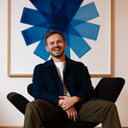




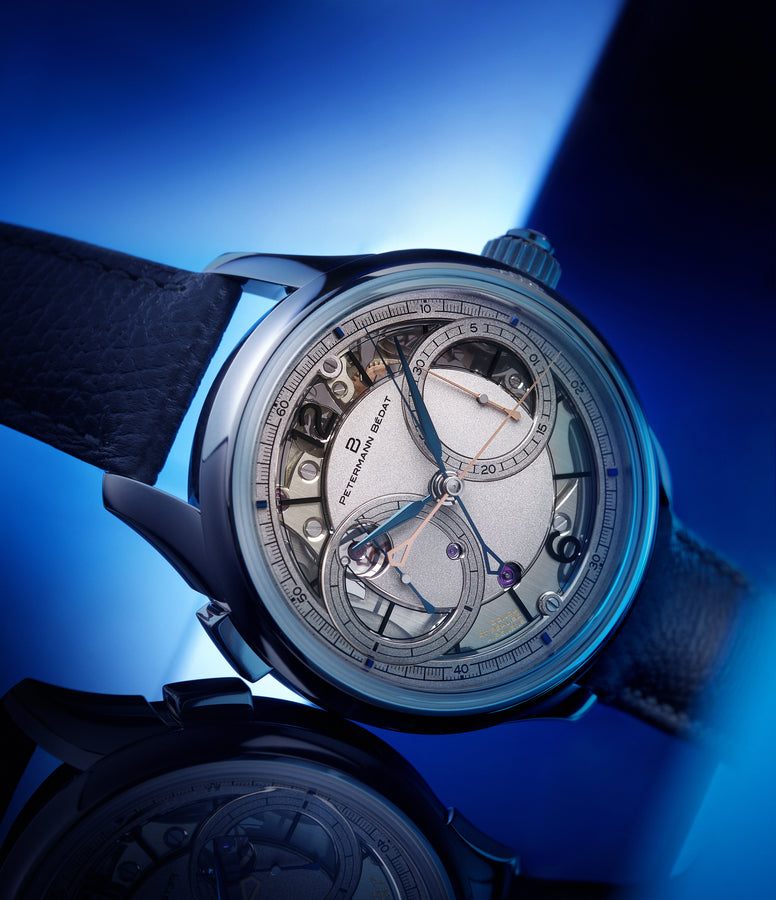








An Afternoon with Sylvain Pinaud
Kwan Ann Tan
The train into Sainte-Croix is bracketed on both sides by deep green forest, the trees creating a tunnel that eventually opens into what once was an industrial town. Home to companies such as Paillard & Co and Reuge — names that were once associated with music boxes and Bolex cameras. Today, the city now boasts a respectable community of watch, clock, and automata makers, including names such as Vianney Halter, Francois Junod, Dominique Mouret, and of course, Sylvain Pinaud.
Pinaud’s workshop is a little way into the winding and steep city roads, tucked on a quieter road. We catch him outside, on the ground floor patio, where he greets us warmly before circling around to the front door.


The view from Pinaud’s workshop, in the heart of Sainte-Croix.
Stepping into the space, which is a dizzying maze of plywood boards sectioning off smaller areas — what Pinaud calls “a little light remodelling” — we see that they have created a circular series of rooms demarcated by vintage machines and tools, where his team mill in and out over the course of their day.
Pinaud’s positive and relaxed mood is infectious, and there is an air of free-spiritedness that is perhaps reflected somewhat in his journey thus far as a watchmaker. Like many other watchmakers today, the trade runs in the family, as his father was a watchmaker. He shares a little bit about his childhood, and creating crazy toys with his father, saying, “I think since I was a child, I have always loved to make things by hand, to understand and to play with mechanisms. So, when I had to choose a job, naturally I chose watchmaking.”


The space that Pinaud and his team have carved out for themselves, and the GPHG Horological Revelation award Pinaud won in 2022.
After completing his studies at the age of 19, Pinaud worked for around three years in an after-sales service workshop, before the urge to see the world became too strong to ignore. With his girlfriend at the time, they travelled around Asia for a year, and even passed a few months skiing in Chamonix, before returning to continue his career, this time in Sainte-Croix.
“After I tried to start my normal career, I arrived in Sainte-Croix and worked in a different workshop. In the end, my factory decided to move, but I didn’t follow them. It was a bit disappointing and stressful at the time,” Pinaud muses. “There was a period where I was wondering if I could do something else, if I could experiment on my own with other things. So, I decided to take a break. Finally, six months after that, I decided to go independent and said: alright, time to give watchmaking a chance and try to live my dream — something I wanted to do ever since I left school.”


Captured at the bench tinkering with a clock project that he has had in mind for a few years.
Walking through the workshop, Pinaud points out three machines that he used in making his first watch, saying that these are the only three tools you really need to make a watch. “You need a lathe, preferably a Schaublin lathe; a milling machine, so a vintage milling machine; and a machine to prepare the cutter for the machine, the tools. With these three machines, a lot of sweat, and a lot of time, you can make a watch.”
Perhaps because of how few machines are used in the handmade process, or the laborious process of creating a watch from scratch, but it’s clear that the process of making his first watch laid the foundations for an idea that Pinaud returns to again and again — that design should feel “simple”, while the process of making should feel “natural”.
Continuing to explain his process in creating his first watch, Pinaud says, “It’s interesting to start with nothing and then experiment so you can try to find a way to make this spring, to make a bridge. That’s also why the first designs are very simple. You have to draw simple pieces which are not too complicated to make with a machine. That’s a philosophy I try to keep in my work now.”
“I truly believe a watch is a little bit like a sculpture. You work with the form and also the texture. I’m always searching for interesting textures, interesting contrasts, to reveal the beauty of the watch.”
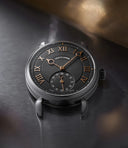
Something else that comes up during our conversation is Pinaud’s willingness to explore and to mould the machines and tools around him to achieve the effect he wants. There is a real spirit of experimentation that is evident within his work. The Origine, for example, has gone through several iterations and configurations of material and texture, with more to come, including gem-set examples.
His desire to engineer and create is an interesting complement to his views on design and process. A glance around the workshop is enough to see the individualistic nature of the machines that give life to the watches, and Pinaud explains, “I often decide to make my own machines to try and achieve the quality that I want with the finishing. It takes many days and weeks to create all the machines I need. For example, on a vintage machine, you might not have the numerical scale for the precision. So, we mix both, the past with the new world.


Vintage machines given new life. Pinaud acquired them over the course of many years.
“Even today, if we decided to come up with a new finishing, we will make our own machine and try to find a way to create a machine to achieve that. Today, the workshop is full of strange machines, Frankenstein machines, and that’s pretty cool.”
There is also the sense that there is a lot of trial and error as the team grapple with the physical nature of the material they work with, in the pursuit of a new way to perform a finishing technique, or to develop a new type of finishing. What stands out is Pinaud’s emphasis on rolling one’s sleeves up to give things a try “We take quite a long time to experiment with many things. Very often, I ask a member from my team to take a day just to try something out” he says. “We have experimented with a lot of different techniques, from grainage by hand on the plate, playing with a different size of grain, different materials, and sometimes you can have a good surprise. For example, with titanium, after you perform matte graining, it becomes an anthracite grey, which is quite interesting, and gives a nice contrast with the anglage.”
Indeed, throughout the day we spend at his workshop, there feels as if a constant running dialogue is taking place across the team, as someone calls another person over to ask for their opinion or help with something, or as they evaluate the outcome of a process.


A glimpse into how work is organised at the workshop, including parts of the gem-set projects that are forthcoming.
According to Pinaud, they often test a new type of finishing on a single part, evaluating it to the highest standards. “All the textures have to look smooth, such as Geneva stripes or sunburst finishing,” he explains. “They have to look smooth and play well with the light. Of course, the process has to be repeatable as well. Sometimes if you make a mistake during a process, you can produce something quite cool, but if it’s a nightmare to recreate? Forget it.”
This hands-on approach and willingness to explore is perhaps summed up best in Pinaud’s own words: “I truly believe a watch is a little bit like a sculpture. You work with the form and also the texture. I’m always searching for interesting textures, interesting contrasts, to reveal the beauty of the watch. Every piece needs a different treatment, and after that, all this will be mixed to create a beautiful harmony.”
But long before the watches are rendered in metal, they first start out as ideas, which are then quickly sketched out and scribbled down. Driving up to lunch at a quaint, old-fashioned hotel set at the top of a winding hill, Pinaud tells us something that sums up a large part of the history of watchmaking, practicality and accuracy aside: “From the beginning, watchmaking is about beautiful objects.”


Stepping out of the workshop into the surrounding forest. Pinaud taking a moment to “play with (and in) time”.
For him, beauty is synonymous with natural shapes and elegant proportions. In a dining room filled with light streaming in through the windows, and overlooking the city below, surrounded by the forests we made our way through when arriving in Sante-Croix, Pinaud explains his process. “The first thing I work on is the face of the watch. It starts with the design, with how I can implement a nice layout — something readable but natural. It can take a lot of time just to be proud about a design. But in the end, sometimes you might have a good design, but you don’t know if you can achieve the techniques to make it work, and that’s what is challenging, but also what makes it interesting. I also might have the idea for a kind of complication or mechanism for a watch I want to make.
“For example, in making a simple three-hander watch like the Origine, for the display I want, I need to rethink the way to make a simple movement. I need to create my escapement, I need to create a special gear train to keep the proportions in check, and that’s always interesting. For the tourbillon, it was also the same. I suppose that’s very often the opposite way that you would make a watch, but it works for me.”
When asked about what he turns to for inspiration or to come up with his designs, the answer is both surprising and yet entirely expected, given Pinaud’s wide-ranging interests. “I think inspiration comes from everything you see, from anywhere. I’m looking at everything — architecture, painting, art, music. But a watch, at the end of the day, is an object. You cannot compare a watch to a building. I don’t know if these things inspire me, but art feeds my watchmaking. But the main inspiration comes from watchmaking itself. What my ancestors have made, how they work on the proportion of their watches. I’m really interested in vintage watchmaking from the 18th century, and what they can achieve with these very simple tools and forms. Their beauty is often very simple.”


Pinaud’s past as a clock restorer is evident throughout the workshop, where he has a lively collection of pieces that he is working on or might work on in the future.
Within design comes a further cycle of iteration and repetition, over and over until the perfect form is achieved on both the dial and the movement. Pinaud admits that it’s difficult for him to settle on the design of the movement, both in terms of architecture and in finding the “right” form. “It’s quite difficult for my team, because I change my mind quite often until I feel it’s quite perfect. Every day I draw wheels and bridges and form, I experiment. When I have an idea, I have to try it.”
But the best form is not necessarily easily made. “If I feel that a design idea is good, I can fight for months and months to find the best way to achieve it,” Pinaud says. “Very often, even if it’s just a simple idea, I will make a prototype just to check if it looks good. I need to feel it and to see it.”


Balance, harmony, and symmetry in asymmetry.
With this, the process comes full circle: the watch is constructed as a prototype, and Pinaud tells us there are faster techniques with which to make prototypes, just to get a sense of the watch’s size and scale. From there onwards, it becomes a matter of translating the intangible into metal, and the process of making.
“When we design the watch, we make the CAD design, and from the first sketch, we think about how we will make it, how we will finish the watch, and how we will assemble it,” Pinaud explains. “At every step you are thinking of the feeling of the person who is in charge of the finishing — for example, some anglages are more organic to do. I always try to make this happen. For me, a good watch is also a pleasure to make. More and more, we also try to work with materials that are more organic, where we can draw out the nature of the material.”
We end the day back in Pinaud’s workshop, in the increasing quiet. Many of the watchmakers start the day early, and by 6, the place is nearly empty, which is when Pinaud has time to himself to think and create, something he likes to do until late in the night. Sitting in his office, he contemplates what it means to be an independent watchmaker today, saying: “To me, independence is about freedom. You can create what you want. You can bring your ideas to life. You can make your own choices, always. And you can also pass more time with experimenting. There’s no pressure, there’s total freedom.”
With a growing team of watchmakers and plenty of interesting things in the pipeline, it’s clear that much is happening or yet to come. Yet there is a level of organisation that is present that underpins a lot of their work. Small things that show the work that it takes to maintain momentum. A timeline of the watches yet to be delivered, the carefully labelled items and testing processes, all steady streams that are balanced below the appearance of freedom.


What makes up a watchmaker? A study in objects.
Pinaud laughs when he thinks about the strange nature of the work that they do. “We continue to use techniques today that are the opposite of gaining time and money. What I do with my team here, especially with the finishing, for example. We continue to make finishing on a lot of parts completely with the file. That’s an opportunity to learn their true work. Everyone in the workshop comes with their own experience, and we all share it.
“I am lucky enough to be able to create the things I want, so I can let my creativity go and make crazy things sometimes. I have a fantastic team with me, where we share our ideas, and we go further together now that I’m not alone, so that’s great.”
Our thanks to Sylvain Pinaud and his team for welcoming us into their space. The director and photographer of this feature is Neal Fagan.


