A changed approach
On launch in 2019, the Balancier Contemporain marked a significant shift for the independent brand. Originally founded by watchmakers Robert Greubel and Stephen Forsey with an unfettered approach to fine, complicated watchmaking that championed the tourbillon, the Balancier Contemporain sought to accommodate this uncompromising approach within more popular proportions. On release, its formula – displaying just the time and power reserve – was one of the most pared-back the independent house had created, placed inside its smallest case up until that point.
It followed in the tradition of the time-only 2016 Signature 1 and the Balancier Asymétrique released the year after (with the addition of a power reserve indicator) – it featured the house’s proprietary balance wheel. While the Balancier Contemporain was originally released in white gold, followed by rose gold in 2021, it would go on to become the third reference after the Signature 1 and the Balancier to also be cased in stainless steel.
In addition to the superlative finish – which even today distinguishes Greubel Forsey from the rest of the field of independents, where fine finishing has come to compete with mastery of complications – the proportions of the Balancier Contemporain marked a decisive change of direction. Featuring the most compact case the brand had created up until that point – 39.6mm across, 46.5mm long, and 12.9mm thick – it was a sign of things to come. It has been followed by references tethered to the metric of improved wearability, in addition to those of mechanical innovation and fine finishing that have long been the brand’s hallmarks. In recent years, references like the Nano Foudroyante have also issued from this new focus.
Execution speciale
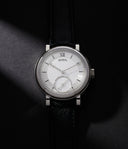
Like the stainless-steel Balancier Asymétrique, this example of the Balancier Contemporain was created in a limited series of 11 pieces for the United States of America. Consequently, the watch wears the ‘execution speciale’ designation as noted on its caseback.
The case is richly detailed. The dial-side sapphire crystal is framed by a polished, rounded bezel that meets a tubular, vertically satinated midcase at a slight lip. The display caseback has a rim that is brushed on top and polished in profile. The lugs, soldered onto the midcase, are straight with a gentle taper and wear a polished finish. Their finish and form – they have a gentle concave camber to their outer profile – distinguish them from the satinated and rounded midcase.
This execution speciale is distinguished not just by the metal of the case but by the rose gold bridges of the manually wound calibre, visible on the dial side. They cascade down from the top of the dial, heightening the three-dimensionality of the dial. The bridges have a frosted finish which tempers the vibrant red shade of the gold alloy they are crafted from.
In contrast, the time scales – the hours and minutes display, the subsidiary seconds register and the up-down power reserve indicator – are fashioned from white gold. Certain elements are strategically exposed – the time display exhibits the gear train underpinning it and also offers a view of the exposed gold mainspring barrel. The open-work aesthetic also accentuates the layered arrangement – the wearer can see how the white gold time display rim sits above a rose gold base. The edges of these layers are decorated with mirrored anglage to amplify this effect.
The rim of the power reserve scale is exaggerated and black polished, reflecting the barrel of twin mainsprings arranged in series to offer 72 hours of autonomy.
The cutout in the hours chapter, between 6 and 8, offers an almost uninterrupted view of the balance wheel. The time display has a black outer minutes chapter. The open-work hours feature arrowheads filled with luminous material. The seconds hand is simple and blued.
A special balance
Perhaps the most attention has been lavished on the balance wheel. Measuring 12.6mm in diameter, the balance wheel is the house’s own design from 2017. It is free-sprung and adjusted using the six gold screws on the rim of the wheel. The large diameter, together with its 3Hz rate, is designed to make it impervious to everyday shocks and therefore better suited to chronometric performance.
Following the theme of form linked to function, the balance is secured by a subtly curved bar bridge that is finely decorated – it is black polished on top, with bevelled edges that have been mirror-polished. The fine finish of the balance wheel and bridge is put on display – the arrangement is suspended over a white gold plate that has been black polished to a perfect mirror finish. The undersides of the balance wheel and bridge – as immaculately decorated as the top surfaces – are reflected on this plate.
The escape wheel and bridge, as well as the jewelled pallet fork, are black-polished and often disappear from view entirely against the similarly finished backdrop.
The movement-side view is entirely taken up by the micro-decoration that has become the brand’s aesthetic code – the text details the brand’s credo and ideals it holds itself to. At the centre lies a rose gold medallion engraved with the brand’s mark and the serial number out of 11. All visible jewels on both the dial and movement sides are fitted with rose gold chatons.
The set and context
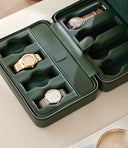
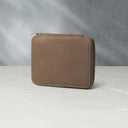
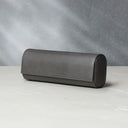
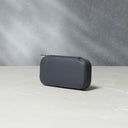
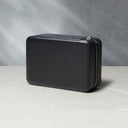
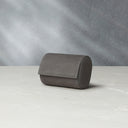
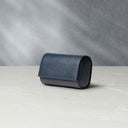
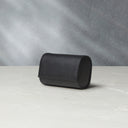
This execution speciale Balancier Contemporain, which retailed in 2023, comes with its full set of inner and outer boxes as well as accompanying paperwork.
The Balancier Contemporain, now a closed reference, was the first of a new kind of Greubel Forsey. Just as mechanically refined and elaborately finished by hand, it also addressed the question of wearability decisively. Balancing its haute horlogerie basis in a wearable case, with bridges crafted from rose gold made wearable by the stainless-steel context, this Balancier Contemporain is a study in poised contradictions. Its rarity is matched by how consequential this reference has been to this independent house.