Vianney Halter announced his independent brand to the world during Baselworld in 1998. The watch he chose for the occasion was the Antiqua. It was the first from his Futur Antérieur collection that imagined a future seen through the vision of the likes of Jules Verne and H. G. Wells. The Antiqua encapsulates that era’s whimsy and wonderings about a future that would never come to pass.
Underpinning the irregular shape of the watch face is a perfectly traditional 36mm round base. Also traditional is the complication it houses – a perpetual calendar. This is set against the innovative design of the Antiqua created by Halter in collaboration with Jeff Barnes, an American graphic designer, with a longstanding interest in horology. It is understood that Barnes had envisioned a wristwatch with four different sub-dials, which reimagined the marine chronometre-style layout Halter favoured with steampunk influences.
Rarest of rare
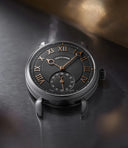
This particular example, forged from platinum with rose gold registers, is one of the scarcest configurations in the rarefied world of the Antiqua. After all, Halter only created 100 or so examples of the reference over an 18 years of production starting in 1999. Of these, fewer than 20 were created with platinum cases. This particular configuration with pink gold registers represents a very small proportion of these Antiquas created in the noblest of metals.
Seeing the warmth of the rose gold within the platinum, steampunk context is like seeing the familiar aesthetic anew. The contrast of the metals adds another dimension to the tension between classicality set against the avant-garde that inherent to the Antiqua.
The Antiqua
Crafted in his Janvier SA workshop in Sainte-Croix, Switzerland, each unit of time in the Antiqua is separated, it’s footprint commensurate with how often the wearer would consult during normal wear. They are framed by windows that are designed to bring to mind riveted portholes on the sides of ships or submarines.
The one expressing the hours and minutes is visually dominant in its scale, followed by the display that indicates the month; this window also incorporates the leap year indicator. This is followed by day indicator while the smallest aperture shows off the digital date. Viewed in profile, these registers reveal their heights to be in the same order of priority as their overall diameter. They feature a circular satinated outer chapter with numerals and text filled with indelible black enamel. The month display holds within it a secondary register for the leap year indication. Similarly, the date wheel wears circular satination and is optically magnified to aid readability. The hands are all heat blued.
Like on the registers, rose gold rivets appear in the rest of the non-functional spaces on the dial side. The platinum case is comprised of 30 different component types (making up almost 100 pieces in total), with no fewer than 104 rivets throughout.
The porthole motif continues to the crown. This is used to set the time and quickset the date. On the left hand side, on the flank of the case are two correctors to manipulate the calendar complication. The concealed lugs are 20mm apart and come furnished with a black, wide-grained leather strap secured by white gold signed pin buckle.
A mystery rotor
The Antiqua is propelled by the self-winding calibre VH198. While based on the Lemania 8810, it was extensively redesigned by Halter. Although the VH198 shares many of the same impressive mechanical elements as the Cal. 8810 (balance-wheel, anchor, escape-wheel and gear wheels), the unique bridges and baseplate are designed by Halter. Visible though the sapphire display back, the VH198 is fitted with a patented ‘mysterious mass’ winding rotor. Using this system, the oscillating mass is hidden behind a peripheral ring, with no apparent link to the central rotor. This allows for an uninterrupted view of the beautifully finished movement. The outer mass and central part of the rotor feature yellow gold rivets.
The mainplate is adorned with Geneva striping with the brand mark and serial number. The self-winding VH198 calibre oscillates at a frequency of 28,800 A/h, with a power-reserve of 35 hours. Running around the display caseback is a satinated rim with details such as the serial number, country of origin, brand mark and precious metal hallmarks.
Accompanying the watch is the original certificate of authenticity.
There is a contradiction at the heart of the Antiqua’s appeal. It is an avant-garde design clad in metals that were long the preserve of classical watchmaking. In this guise, where the rose gold dials bring warmth to the platinum case, this tension between opposing elements is heightened. It is a delectable example of a seminal reference by one of the earliest and most original independent watchmakers.