Urban Jürgensen has a rich history that goes back to the late 18th century. The manufacture’s namesake, Urban Jürgensen (1776-1830), along with his father Jürgen Jürgensen, has long been credited with introducing the watch industry to Denmark. Shortly after the birth of his son Urban in 1776, the senior Jürgensen moved to Le Locle in Switzerland to work with Jacques-Frédéric Houriet, laying the foundations for a Danish-Swiss connection which persevered well into the late 20th century.
In more recent history, Peter Baumberger acquired the brand in 1976 and together with master English watchmaker Derek Pratt set about bringing the Urban Jürgensen name – and the legacy of elegant and complicated timepieces it conjures – to the modern era. Pratt, of course, is one of the most accomplished watchmakers of the 20th century and was a long-time collaborator of the late Dr George Daniels. Also worth noting is the contribution of a young Kari Voutilainen to the Urban Jürgensen brand during these early years. It is fitting that Voutilainen continues to play a part in guiding the trajectory of the recently revived Urban Jürgensen brand.
The lore
Another watchmaker, who among other contributions, played a part in designing the remarkably thin and complex fan-style power reserve indicator first seen in the Reference is linked to the story of this particular Reference 2. Jens Bloch worked closely with Pratt on the mechanics of the power reserve indicator, underpinned by a slim differential-based set up.
The Reference 2
Starting in 1986, Urban Jürgensen produced the Reference 2 in a classical 38mm case and powered by the Frédéric Piguet calibre 71, topped with a perpetual calendar module. It was significant as the first Urban Jürgensen wristwatch reference to feature a perpetual calendar. The observatoire hands – that would become a design mainstay – were also first employed in the Reference 2. The dial is a canvas for Pratt’s skill with hand-turned guilloché, featuring two distinct patterns.
While around 175 examples of the Reference 2 are believed to have been produced, approximately 50 of these were made in platinum with the rest produced in yellow and rose gold. Examples in white gold were made by special order. This platinum Reference 2 comes with recent paperwork from the brand signed by Kari Voutilainen.
The case, dial and calibre
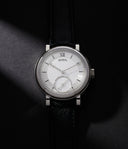
The platinum case is almost perfectly rounded, with this uninterrupted form extending to the stepped bezel. The closed, circular brushed caseback also meets the midcase in a similarly stepped fashion. The knurled crown is topped with the brand mark. Three sunken correctors on the midcase help manipulate the calendar functions. The lugs, with their teardrop profile, are soldered to the midcase. They are fitted with a black, large-grained leather strap. The strap is secured by a simple, signed yellow gold pin buckle.
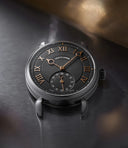
A thin chapter of minutes is separated from the Roman hours by a sauté piqué rim. Both graduated chapters are achieved on satinated rims, as is the chapter for the subsidiary date register. The hour chapter is interrupted by the day and month display windows as well as the date complication. On the northern half of the dial, lining the semi-circular brand mark, lies the moonphase display. Set on a polished steel disc, heated till blue, are the shimmering gold-filled cut outs of the moon and stars.
The central portion features hobnail engine turning applied using hand tools. For visual distinction, the watchmaker employs a basket weave pattern inside the subsidiary date register, with this decoration repeated on the partial covering of the moonphase display. The resulting effect is classical and refined.
Under the closed caseback lies the well-decorated 2.4mm-tall Frédéric Piguet calibre 71, topped with the thin perpetual calendar module, developed by Lemania. The movement features an off-centre winding rotor that Urban Jürgensen upgraded to one made from 21k solid gold. It featured a single barrel out of which it got 48 hours of autonomy.