Back to Origine
Having worked in the watchmaking industry for over 20 years before starting his brand, Sylvain Pinaud’s experience is extensive as it is colourful, with his independent workshop simply the culmination of his creative and technical watchmaking journey so far.
His experience is evident in his watches, demonstrating mastery of craft and a sharp focus on carefully chosen details. The Origine is the second watch from Pinaud, following up on his Chronographe. It inherits several aesthetic cues, such as the semi-openworked dial, and industrial, yet contained style he has developed. What makes this watch especially remarkable is the innovative rearrangement of the movement to put the balance wheel at the front of the dial, evidence of his ability to turn the tables on convention. Pinaud mentions that bringing the wheel to the front of the movement was tricky, as it required him to rethink and redesign the gear trains which connected to the time telling functions.
According to Pinaud, the watch is named “Origine” not only because he drew inspiration from the early days of watchmaking, but it was inspired after spending some time with his father in his hometown – he wanted to remember his roots, where he came from, and “that everyone has an origin”. His method of design is also especially unusual, as his focus is on the design of the watch first, before working on the movement and figuring out how to bring his ideas to life.
The Origine won the Horological Revelation Prize in 2022 at the GPHG Awards, in recognition of his talent as an emerging independent watchmaker and his remarkable watch. This edition is part of a special collaboration with A Collected Man, featuring a unique colourway and more minimalist appearance.
A Collaborative Conversation
The goal with this trio of pieces was to explore what is possible with different textures and finishing across the design of The Origine. Often, when confronted with options for customisation, most would gravitate towards the most impressive aesthetics or expression of craft. However, we chose to go for the most restrained version, removing layers of distraction to allow the wearer to admire the textures of the hand finished dial.
According to Pinaud, “With these pieces, we pushed that idea to its extreme: removing almost all colour contrast and creating contrast entirely through the different surfaces, textures and their interaction with light.”
This became a challenge, and according to Pinaud, one that tried to demonstrate “how far we could take the monochromatic approach while keeping the watch alive and expressive.”
The Dial
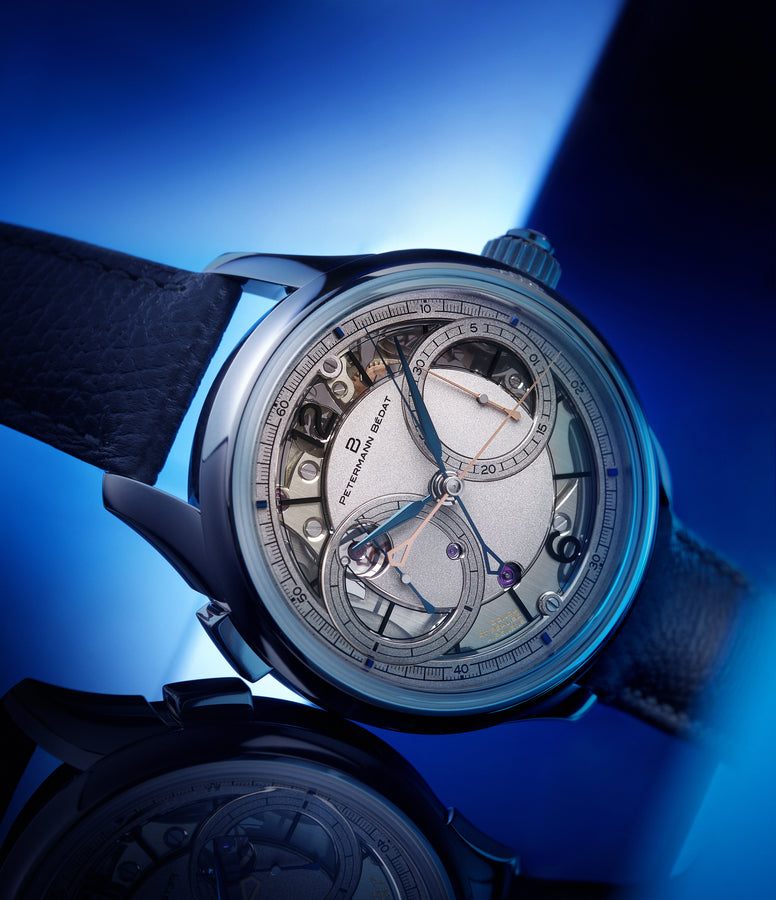
Made entirely in-house at Pinaud’s workshop, the aim was to create a modern configuration in terms of colourway, paring back certain elements from the original piece and highlighting Pinaud's singular style of finishing. The watch features a grey colour scheme, exploring the breadth and depth of stainless steel as a material.
This stainless steel iteration is the closest to the original design of Pinaud's Origine, while expressing our version of what the purest form of this piece could look like. The textures and minimalist appearance provide an excellent contrast against the complexity of the open dial and the depth of the layers visible there.
Pinaud mentions that one of the references used when designing the dial was a watch from the early 19th century. "At that time, dials were of great simplicity, designed for legibility, with a discreet elegance and without artifice," he says. "This is exactly what I'm looking for in a watch: a balance between function and form, where every detail has a meaning, without ever yielding to excess.
The finishing is entirely done by hand in Pinaud’s workshop, through a combination of traditional and specially developed techniques. Significant attention has been paid to achieve the uniform shade of grey and gentle texture of the matte finishing. These contrast beautifully with the polished elements, and circular brushing has also been applied to the chapter rings of the sub-dials. Overall, the techniques are grounded in a tradition that stretches back centuries, applied to a modern context.
A recurring circular motif can be found throughout the dial, within the refined appearance of the nestled outlines of the dials juxtaposed against the exposed, mechanical forms of the balance wheel and escapement. The shape of the bridges is reminiscent of 18th or 19th century French watchmaking, where some watches featured the escapement on the front, as well as the combination of straight lines and circles.
The dial is mostly asymmetrical, with the time-telling register on the right and a subsidiary seconds slightly overlapping it on the left. Both are slightly raised, with alternating textures of matte on the central section and circular brushing on the lighter grey parts of the main dial, as opposed to the regular Origine pieces, where you see concentric circles on the seconds sub-dial and a matte hour ring. Furthermore, Pinaud deftly plays with perspectives, as the seconds sub-dial is the same size as the inner section of the main dial. The typical placement of the signature has shifted to below the seconds sub-dial, in a discrete engraving of Pinaud's name, as opposed to printed on the dial. Notably, the printing of the dial has also been simplified, retaining Pinaud's signature '12' numeral but keeping the hour markers simple and only minimalist dashes remain on the seconds sub-dial.
The three-armed balance bridge is secured to the Breguet overcoil hairspring below with a central jewel, while black polished twin bridges and accompanying pins sit below. Each component visible in the lower half of the dial is finished to an extremely high standard. The opening, cut into the baseplate itself, is bevelled and polished, while anglage is used throughout, and is executed to a very high level, with several inner angles and polished countersinks. The balance bridge itself is black polished to a gleam, mirroring the polished parts of the dial and the screw. Meanwhile, the escapement bridge is matte polished, in an echo of the finish found on the other parts of the dial.
The Reverse
Turning the watch over reveals a three-quarter plate crafted from steel. Present are finger bridges and a small glimpse at the steel wheels, as well as cut outs that put the gear train and balance support on display. Given that the centrepiece of the movement has migrated to the dial, Pinaud gives us a more restrained and elegant reverse, with fewer things to focus on. In place of where the balance wheel would traditionally be, is the recessed plate that supports the balance wheel on the dial. In this space is engraved “Sylvain Pinaud”. The watch is also engraved with "Piece Unique" on the bridge, closer to the top of the case.
Pinaud refers to the style of matte finishing he uses on his watches, marked by a softer appearance suited to the dial as well as movement sides, as “grainage”. This grainage provides a muted backdrop for the rest of the components to come together harmoniously, blending more naturally with the rounded shapes across the rest of the movement. This style of finishing is notoriously difficult to execute on a large surface because the size makes achieving a homogenous texture challenging.
When paired with the steel, this has an especially velvety, textured appearance, completely transforming our usual associations with the material into something softer. This also has the effect of matching the matte elements on the dial side, allowing the theme of texture to continue seamlessly across the entire watch.