Audemars Piguet and Philippe Dufour are rightly credited with reviving the tradition of grand et petite sonnerie watches in the last two decades of the 20th century. In fact, it was the Le Brassus brand that commissioned Dufour to create a series of five pocket watches with this classical chiming complication. When Dufour went independent, he continued in this vein by first making similar pocket watches with this complication and following it by creating the first grand et petite sonnerie wristwatch in 1992.
A few years on, Audemars Piguet followed this with three manually wound grand sonnerie calibres – the quarter repeater calibre 2868; the carillon minute repeater calibre 2890; and the ultimate iteration, the carillon minute repeater calibre 2891 with dynamograph. These grande sonnerie calibres, a first for the historic house, were conceptualised by specialist movement maker Renaud et Papi. While the calibre 2890 was created in 1994, four years later the brand developed the more complex and musical carillon chimes fitted to the calibres 2890 and 2891.
In total, the brand created 188 examples of these three grande sonnerie calibres between 1994 and 2002. Of this number, just 41 examples were of the carillon dynamograph calibre 2891.
A brief history of the carillon
While in watchmaking a carillon refers to a minute repeater that relies on three or more hammers to produce a more complex and melodious sound signature, it draws from an older history. It dates back to the 16th century tradition in Belgium and the Netherlands of striking an arrangement of at least 23 cast bronze bells in a variety of sequences to create a melody to commemorate a public event. Some of the best-known carillon towers include the Cathedral of St. Peter and St. Paul in St. Petersburg and the Carillon du Passage Malbuisson in Geneva.
The carillon was miniaturised for pocket watches, with the 19th century Perrin Frères quarter repeater a notable example. However, it remained scarce in wristwatches throughout the 20th century. While in the space of modern artisanal watchmaking the complication has had a resurgence in recent years, this trajectory could be traced back to the Audemars Piguet Jules Audemars Grande Sonnerie Carillon Dynamographe reference 25945 first seen at the erstwhile Baselworld in 2000.
Before getting into the details of this particular example of the reference, it is worth briefly coming to terms with its other technological detail, the dynamograph.
The dynamograph
A Renaud et Papi innovation, the dynamograph was first seen in a wristwatch calibre in 2000. It visually represents the real-time internal tension of the mainspring based on the reading of a direct barrel force sensor. The mainspring torque is understandably highest when the mainspring is fully wound, plateauing in the middle before dropping off as it nears the end of the wind. The top end and middle plateau provide torque ideal for linear chronometry, displayed in the scale of the dynamograph, or couple indicator – this corresponds to the hand being in the bottom to middle portion of the up/down scale. As it is inches up, it provides a visual cue to the user to wind the mainspring.
This functionality is particularly useful given energy intensive grande et petite sonnerie complication.
The complication made its way to other significant and limited series references underpinned by calibres developed by Renaud et Papi such as the Audemars Piguet Royal Oak Concept Watch 1 as well as the Richard Mille RM 001 and 004.
The reference 25945PT
Produced in a series of just 41 examples, the reference was created in white gold (12 pieces) with the remaining in platinum (reference 25945PT), it is emblematic of Audemars Piguet’s renewed commitment to preserving classic complications and breathing new life into them by means of mechanical innovation.
Central to this project is the calibre 2891, developed by Renaud et Papi. It is comprised of 496 components. As noted previously, it features double stacked barrels and a monometallic balance with lever escapement. The mainspring for the sonnerie can support 60 hours of petite sonnerie and 20 hours in the grand sonnerie mode. The drive train has 48 hours of autonomy when the mainspring barrel is fully wound.
The bridges are adorned with Côtes de Genève, while the edges are bevelled and polished. The mainspring wheel is solarised.
The jewels feature mirror polished countersinks while the jewel on which the escape wheel pivots features a black polished chaton. The screw heads are black polished too.
Running on the periphery are three gongs that are struck by the three, black polished hammers of the carillon grande sonnerie complication. The hammers, while different in profile, are weighted so as to have an equal sound signature. The lowest hammer strikes to announce the hour, while all three strike in programmed sequence to announce the quarter, while a single hammer strikes to indicate the minutes past the nearest quarter. This sonnerie can be triggered on command by the pusher at 10 o’clock. Alternatively, the three-position slider at 2 o’clock can be set to silence, or to chime the hours, quarters and minutes (grande sonnerie) or just the hours and quarters (petite sonnerie).
It produces a sound signature that is as complex as it is melodious. That it does this despite the modern convenience of an exhibition caseback speaks volumes of the design thought behind the calibre.
The case and dial
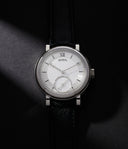
The platinum case of the reference 25945PT is classical and finely detailed. It measures 39mm across, with a compact lug-to-lug distance of 45mm. It features a range of finishes – the rounded midcase is horizontally satinated, while the short lug originating from this part are vertically satinated in profile. The lightly cambered bezel is polished and features a facet also similarly finished. This finishing and detail are repeated on the movement side – the exhibition caseback bezel is adorned with the brand mark, serial number and the name of the watch. The tops of the lugs are polished, as are the sonnerie pusher and the three-position selector. The crown features a domed facet and knurled edges. It requires pulling it out to the first position to wind the mainspring and to the second position to set the time.
Crisp, precious metal as well as brand hallmarks adorn the flanks of the left lugs. The lugs stand 20mm apart and come furnished with a large-grained black leather strap secured by a signed, platinum deployant clasp.
The silver dial has an unusual finish, typical of the movement side. Hemmed in by a sauté piqué rim is an expanse of straight-line Côtes de Genève-style adornment. The lightness of the texture gives this section a warm, glowing appearance. It features an applied brand mark as well as the subsidiary seconds register at 6. The latter overlaps with the up/down dynamograph or ‘couple’ display. Anchored at 1 is the fan-style power reserve indicator. The polished chapter of applied Roman numerals and the similarly finished leaf-style hands play with the light.
In context
The Jules Audemars Grande Sonnerie Carillon Dynamographe represents a particular moment in time marked by a renewed commitment to complicated watchmaking, powered by modern machining and technology. That the reference 25945 is cased in platinum, a metal traditionally the preserve of the finest watchmaking, makes this balance of classicality and modernity all the more delectable.