The context
The acoustic concept of resonance in clock and watchmaking is age-old. It was first identified by Christiaan Huygens in the 17th century, who realised that suspending two pendulums from the same anchor and in proximity to one another would result in them eventually synchronising and swinging at a similar frequency. Employing this principle but placing the two frequencies emanating from twin balances in opposition to one another could then, in theory, help consistently cancel out errors of frequency in either. This principle would aid linear chronometry. This theory was furthered in the 18th century by the likes of Antide Janvier and Abraham-Louis Breguet, first in clocks and then miniaturised for pocket watches. In more recent times, F.P. Journe has brought the principle to the wristwatch.
The 2016 Armin Strom Mirrored Force Resonance offered a more tangible evolution. It linked the balance spring studs of the two free-sprung balances, beating in opposition to one another, with a resonance clutch spring. Such a physical linking was the brand’s innovation to the concept of resonance in wristwatches. This arrangement made the synchronicity more immediate – when wound from a dead stop, the balances reach resonance in about 10 minutes. When offset due to shock, resonance is restored within a matter of minutes. Owing to the brand’s vertically integrated operation, research and development was done in-house over a course of two years, under the leadership of technical director Claude Greisler.
The next innovation
Then, on the 10th year of the brand’s rebirth, and to celebrate a new manufacture in Bienne, Armin Strom layered acoustic resonance onto the mechanically linked resonance that the brand had come to be associated with, in the Masterpiece 2 Minute Repeater Resonance. The mechanics and design of the sonnerie – conceptualised by complication specialist Le Cercle des Horlogers – are paired with a totally transparent aesthetic championed by watchmaker Armin Strom, after whom the brand is named. Such a combination of resonance and sonnerie was a first in watchmaking. It was created in a series of 10 pieces.
Mechanics as aesthetic
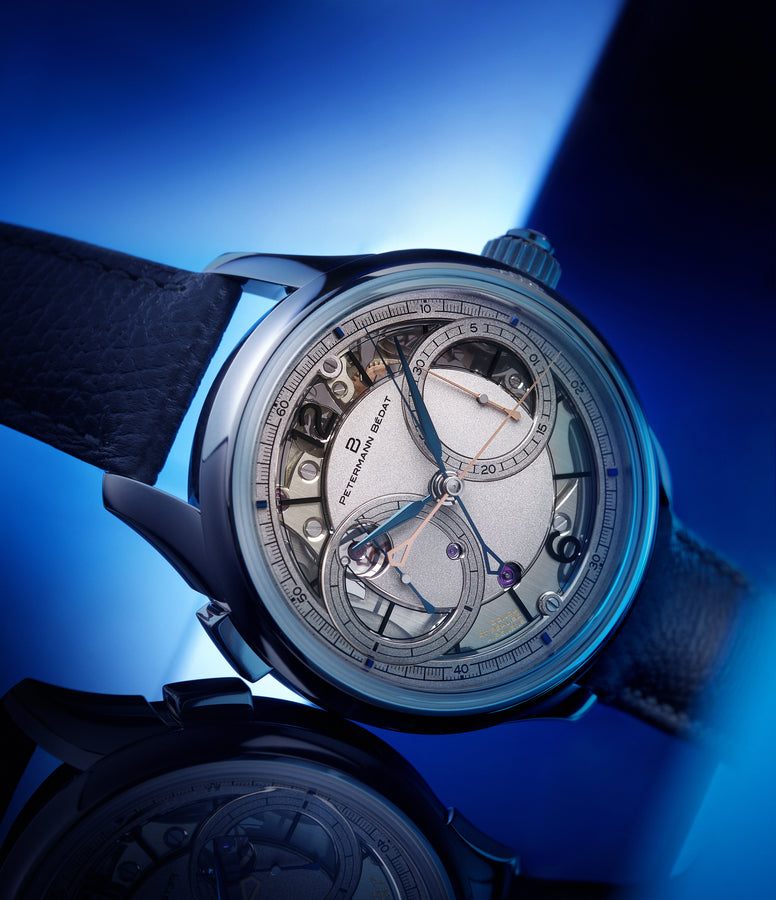
The form of the twin-barrel, twin-gear train and twin-escapement calibre ARR18 is intrinsic to the aesthetic of the reference. While the brand favours a twin-seconds indication to display resonance, it forgoes this in the Masterpiece 2 Minute Repeater Resonance to accommodate the sonnerie. The twin balances – anchored by rose gold bridges and linked by the resonance clutch spring – are located at 6 o’clock, with the smoky sapphire time display placed just above them. At 12 lie the two hammers of the sonnerie, while the gongs snake around the time display.
The smoky sapphire time display offers a glimpse of the twin gear trains without overshadowing readability. There is plenty of evidence that the mechanics were always designed to be central to the aesthetic – the horseshoe-shaped bridge under the dial that anchors the wheels of the going train is skeletonised and, together with the form of the bridge that holds the centrifugal governor for the sonnerie, is reminiscent of the brand’s ‘AS’ logo. In fact, the rose gold AS logo on the dial perfectly overlaps the jewel of the centrifugal governor, another instance of thoughtful design.
Much of the architecture of the minute repeater lies on the movement side – the levers and cams are on full display and, when the complication is engaged, make for enjoyable viewing. In the bottom half are the twin, stacked and sequential mainsprings. They are topped with a circular bridge that exposes the twin click springs engaging with the ratchet wheel. Mirroring the dial side, two rose gold barrel bridges frame the power source and winding mechanics.
While a frosted, silvered plate separates some of the dial-side mechanics from those on the movement side, with the goal of visual order and readability, it is strategically open-worked in places – on the dial side, it shows off some of the mechanics of the minute repeater. On the left side of the dial, the mechanics are laid out to be airy and see-through.
Finishing
The frosted finish of the red gold bridges is hemmed by highly polished bevelled edges. The latter finish carries on to the Roman hours and the lancet hours and minutes hands. The beautifully rounded gongs are polished, while the hammers and part of the bridge anchoring the resonance clutch spring are black-polished.
The balance of finishes on the dial – the frosting on the dial plate, the circular and vertical brushing – is well balanced and attractive. This range of finishes continues on the
movement side.
Case
Integral to the sonnerie are the material and the proportions of the case. Crafted from titanium, measuring 47.7mm across and standing 16.10mm tall, it is the perfect soundstage for the minute repeater complication. The sonnerie reverberates through the case, producing a sound signature that is distinct and measured. The right hammer strikes to announce the minutes. This is followed by both hammers striking alternately to mark the quarters. The left gong then announces the minutes since the last quarter. Each sonnerie sequence is well spaced, so it is usable.
The case is brushed with polished facets. The bezel has a polished plaque at 6 o’clock, which is the brand’s visual signature. While it is left blank on this example, the brand obliges clients who choose to customise theirs by engraving a detail or motif on it. The exhibition case has a circular-brushed rim embossed with details such as the 3 ATM water resistance and country of origin.
The lugs are short and taper down sharply. They feature a polished facet and stand 22mm apart. The strap is secured with a titanium butterfly-style double-deployant clasp.
The significance
This very last expression of the Masterpiece 2 Minute Repeater Resonance represents a real show of intent. While thoroughly modern, it is reminiscent of the maximalist, uncompromised and brave approach that characterised the earliest days of independent watchmaking.
If sold within the United Kingdom, this Armin Strom Minute Repeater will be subject to 20% VAT