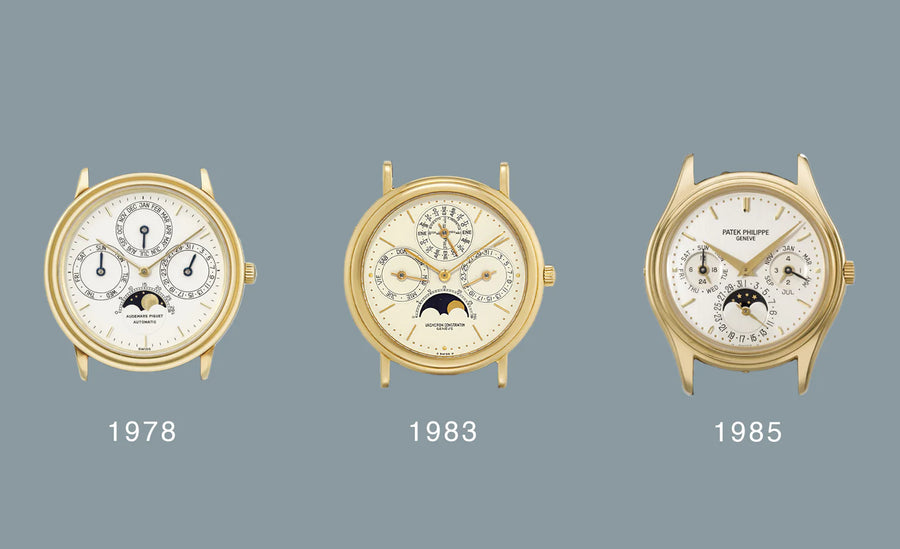
The Patek Philippe Reference 3940 is perhaps the most iconic perpetual calendar of the modern era. The design, balanced and restrained, had details specific to each of the three series it was produced between 1984 and 2007 (plus the 25-piece series for Beyer and the pre-series). This makes it especially attractive to the detail-minded collector. Paired with the slim, micro-rotor calibre 240Q, the 3940 was always destined to be a modern classic.
MSO signed
This example of the 3940 is one of a collection of unique Patek Philippe watches commissioned by Michael Steven Ovitz, founder of Hollywood talent agency Creative Artists Agency (known for representing actors Dustin Hoffman, Tom Cruise, Bill Murray and Barbara Streisand among others) and former president of The Walt Disney Company. He is a noted watch collector, best known for his unique commissions which bear his stylised MSO crest on the dial. The collection includes unique examples of the reference 3970, 5070, 8139, 5059, 5040, 5004 among many others; some of these have come to auction over the years.
The 3940 was a particular favourite and Ovitz’s collection featured several unique examples in a variety of metals and dial colours and details. They share several characteristics such as his preference for applied Breguet numerals and feuille-style hands.
Points of distinction
This example, sold to Ovitz in 2014, seven years after the reference had been discontinued, is a balance of its many interesting, unique details.
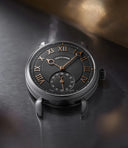
True to his preferences, the watch features a chapter of applied gold Breguet hours and feuille-style hands. However, in this example, both are illuminated with Super-LumiNova. The detail gives the familiar 3940 aesthetic a contemporary refresh.
This is laid out against a rich black backdrop, another point of deviation from the 3940 aesthetic. While based on the third series of the reference, the unique colourway helps see the 3940 anew. All printing and scales are in white while the register at 6 o’clock – home to the date and yellow gold moonphase indication – is encircled by a gold ring. The MSO signature, a detail Ovitz often included in his unique commissions from Patek Philippe, is discretely included at the bottom of this register.
It speaks to his importance as a collector that the historic brand honoured this request.
The case
The three-part yellow gold case – measuring a classical 36mm across and standing just 8mm tall – is beautifully rounded. The concave bezel gives way to the rounded midcase from which the lugs flow organically. The knurled and signed crown is partially recessed in the midcase. In between the lugs lie three of the four correctors for the perpetual calendar complication. The fourth corrector lies at 9 o’clock.
The lugs, 18 mm apart, all feature precious metal and makers' hallmarks on their undersides. This is where the hallmarks are typically found from later series of production. This watch comes with a display caseback as well as an additional closed caseback – a detail also typical of last series of the 3940.
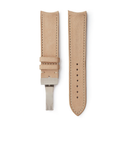
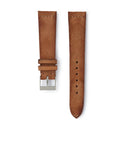
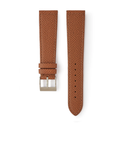
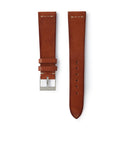
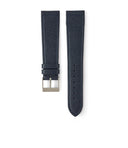
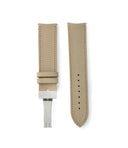
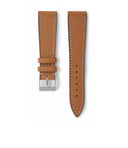
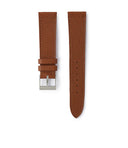
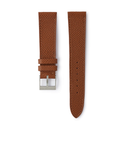
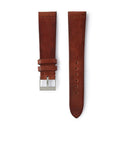
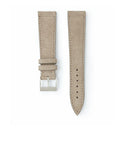
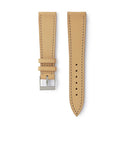
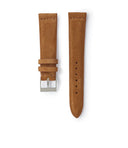
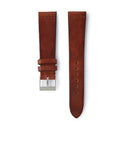
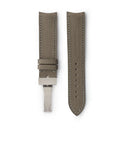
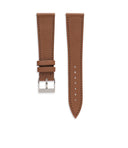
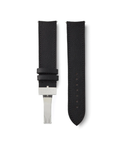
The lugs are furnished with a large-grained leather strap in a rich brown, secured by a matching yellow gold deployant clasp with the Calatrava motif, as most examples of the reference after 1997 feature.
The dial
Other than the unique details noted previously, the dial bears several traits in common with the third series of the 3940. It still features the modern san serif fonts typical of the third series.
A detail that is conspicuous by its absence is the "σ SWISS σ" mark at 6 o’clock – this print is a constant feature of the 3940. It has been jettisoned in this, and other unique 3940s that Ovitz has commissioned.
In between the luminous plots corresponding to the hours lies a chapter of drilled minutes. Each register expresses two units of time. The one at 3 has an outer chapter of the 12 months of the year, while within lies the sectored leap year indication typical of the third series. Similarly, the register at 9 has an outer chapter of 12 months, while inside lies the 24-hour indication. The sector at 6 incorporates an outer chapter of the 31 days of the month, while within lies the moon phase display. The latter is built on sapphire glass, giving it a lustrous quality.
The inner leap year register at 3 features circular graining. The numerals, as noted previously, still have a delicate serif quality to them. Particularly noteworthy is the date register, where the numerals are elongated, in a similar fashion to the Reference 3448. The date indicator is large and feuille-shaped and crafted from gold. The other two registers also feature smaller gold feuille hands for the day/night and leap year indication. Larger, blued stainless-steel feuille hands indicate the months and days. The hours and minutes indicators are crafted from gold.
The calibre
Visible through the display caseback is the technical and aesthetically impressive self-winding 240Q. It measures under 28mm across and stands just 3.8mm tall, wound by a 22k gold micro-rotor. It beats at 21,600 vibrations per hour and when fully wound, the mainspring offers 45 hours of autonomy.
It is finely adorned, with perlage on the baseplate and the bridges finished with Geneva striping and their bevelled edges hand-finished to a mirror effect. The brand mark, jewel count (27) and the movement’s adjustment to five positions is detailed in gold engraving on the bridges. The Geneva seal, a constant feature of Patek Philippe in this era, is also similarly engraved on the bridge.
The set and context
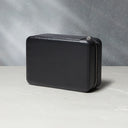
This example comes with its full set of original paperwork issued to Ovitz, as well both inner and outer boxes.
The reference 3940 is now well established as a modern classic. Seeing it in this unique context is refreshing and further proof of the versatility of the 42-year-old design. That this exists and it was commissioned by one of the most tasteful collectors of the modern era is yet another aspect for our appreciation of this watch.