The history
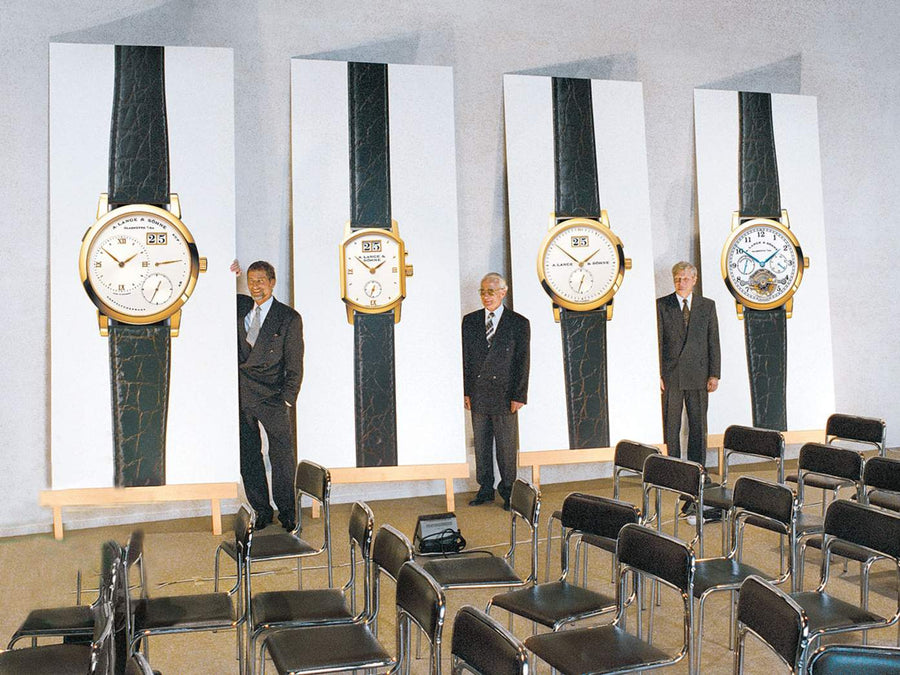
When A. Lange & Söhne was resurrected by Walter Lange (great-grandson of founder Ferdinand Adolph Lange) and Günter Blümlein (who had previously overseen the resurgence of IWC and Jaeger-LeCoultre), they did so with four lines – Arkade, Saxonia, Tourbillon Pour le Mérite and the Lange 1. While each bore a distinct design language, the Lange 1 has come to be viewed as the quintessence of A. Lange & Söhne and the purest expression of Glashütte watchmaking.
Elemental to this is the decentralised display. Drawing lines from the centre of each display – the time, subsidiary seconds and the date – would result in an isosceles triangle. The layout is an inspired work of industrial design, revealing a deep understanding not just of proportional use of space but also of how the wearer will interact with the watch face.
The Lange 1 has also been a canvas for the brand’s experimentation with metals, materials and finishes. Perhaps the most interesting executions are when A. Lange & Söhne pushes the boundaries of the Lange 1’s aesthetic.
Early and understated
This reference 151.025 is an early example often referred to as the "Stealth", thanks to its entirely monochromatic dial and platinum case. The understated quality is balanced by the integrated 15-link platinum Milanese-style bracelet crafted by historic jeweller Wellendorf. The lugless aesthetic also gives the reference a unique presence in the pantheon of Lange 1.
Some of the features that further highlight the fact that the piece is a very early example include the small “Made in Germany” text below the sub-dial in a sans-serif font with a more condensed format. Later examples are printed in ‘Engravers MT’, a serif font, which has noticeably thicker lettering compared to the font found on this piece, while the text is more spread out. Further subtle differences can be found in the fact that the umlaut above the “ü” in “Glashütte” is slightly separate from the letter itself or that the “I” in “I/SA” (“In Sachsen” – “in Saxony”) sits above the halfway point of the slash, amongst a few other details.
The dial and case
The decentralised time display that is elemental to the Lange 1 reinforces the pared-back aesthetic. Within the silvered expanse of the dial, the largest island of information is the hours and minutes register, finished with closely packed concentric rings and an applied quarter of Roman numerals interspersed with diamond-shaped hour markers. The chapter of black printed minutes lies outside it. The marginally overlapping subsidiary seconds register also has a similar base and a black printed sector-style chapter.
At 3 o’clock is the ‘up-down’ power reserve indicator, its scale also printed in black. The slim, alpha-style seconds hand is complemented by the similarly formed indicators for the hours, minutes and power reserve displays. The panoramic date, framed by a white gold window, is believed to be inspired by the Five-Minute Clock at Semper Opera House in Dresden.
The rest of the dial further underlines the masterful use of negative space, furnished only with the brand mark at 12 o’clock, the country of origin printed prominently underneath the time display and the ‘Doppelfederhaus’ mark running along the arc of the bottom half.
The three-part platinum case appears as an extension of the silvered dial. The case features a high-polished bezel, with the caseback’s faceted edge decorated with a similar finish. This detail of the caseback gives way to a brushed rim that contains the display caseback. In between the screws that secure the caseback are engraved details such as the brand and Glashütte marks as well as the hallmarks of the precious metal of the case and the casemaker. The satinated midcase features a squared pusher adjuster to quickset the date and is also the source of the stepped lugs that gently curve down. In place of the lugs is the 20mm-wide, Milanese-style platinum bracelet, separated from the case only by the difference in its texture.
The calibre
Underpinning the aesthetic is the manual-winding calibre L901.0, offering 72 hours of autonomy. The watch has a lever escapement and the balance beats at 21,600 A/h. In true A. Lange & Söhne style, the impressively finished movement, with its dominant three-quarter plate decorated with Glashütte ribbing, features chamfering and anglage done by hand. The visible working jewels are ensconced in gold chatons, while all visible screws are heat-hued to a vibrant blue. The bridges and plates are crafted from German silver, while the balance cock features intricate hand-engraving. Both are signature elements of A. Lange & Söhne.
The watch comes with a recent certificate of origin from the brand.
The significance
The reference 151.025, while in most ways entirely within the strictly regimented world of early A. Lange & Söhne, manages to be an outlier. It is in these instances, few and far between in the more modern offering, that the brand shows its ability to surprise. It makes it very attractive to the informed collector of the esoteric.