








































Maximal Handwerkskunst
Handwerkskunst, or craftsmanship, is a hallmark of every single watch A. Lange & Söhne has created since its rebirth in the early 1990s. What sets the small number of watches the brand makes under the Handwerkskunt programme is intention.


The hand craft isn’t an element of the watch. It is its very reason for existing.
Since 2011, A. Lange & Söhne has created just eight Handwerkskunst references. This 1815 Rattrapante Perpetual Calendar Handwerkskunst was the sixth.
It was the first to feature several styles of hand craft, seen individually in the Handwerkskunst watches that came before, layered artfully.
The craft created greater order and even space for storytelling.


Relief engraving


Hinged caseback


Star-studded calibre


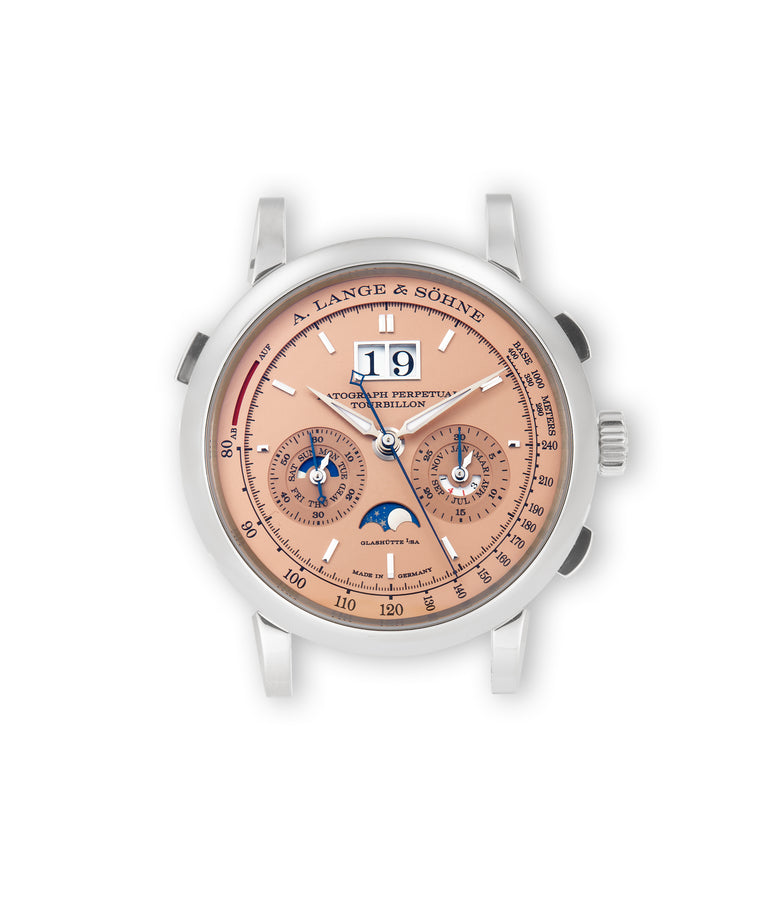
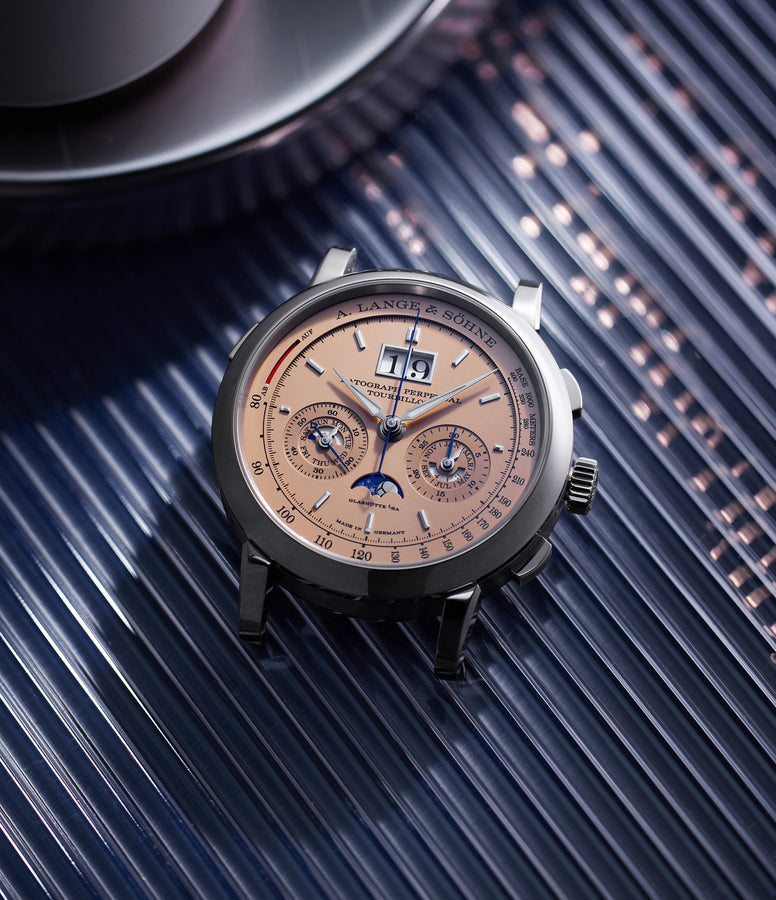
This is one of 20 examples of the 1815 Rattrapante Perpetual Calendar Handwerkskunst*. It’s 41.9mm white gold case also features a hinged caseback. The dial is adorned with relief engraving sealed in with translucent blue enamel, a treatment also found on the brand's first hinged caseback. A relief of the Roman goddess Luna, created by hand, is also found on the caseback. The watch is powered by the manually wound calibre L101.1 whose bridges are also decorated with relief engraving.
To know the story of Luna is to learn of a love that perseveres, no matter how impossible it may seem.


According to Roman myth, Luna was born to Hyperion and Theia, titans of light and sight respectively. Her siblings were the sun (Sol) and dawn (Aurora) and she herself was viewed as the personification of the moon and night. As such, Luna was viewed as the goddess who influenced farming cycles and fertility. Together with her brother Sol, she was viewed as crucial to the passage and measurement of time. Luna appears in mythology with a crescent moon diadem, a pulled back veil and a torch in her arm, travelling on a two-horse chariot across the skies.
Legend has it that the goddess fell for a mortal.
Luna’s love for the shepherd called Endymion could never be fulfilled so she took pleasure in visiting and watching over him as he slept, every night for eternity.
She is immortalised on the back of the hinged caseback of the 1815 Rattrapante Perpetual Calendar, carved in relief by hand and surrounded by a permanent starry, similarly created. The night is permanent, much like her love and predicament, fixed in brilliant translucent blue enamel, so Luna never has to leave her lover.


The Watchmakers Journey







Want to hear more?
Sign up and be the first to hear about our latest watches.
