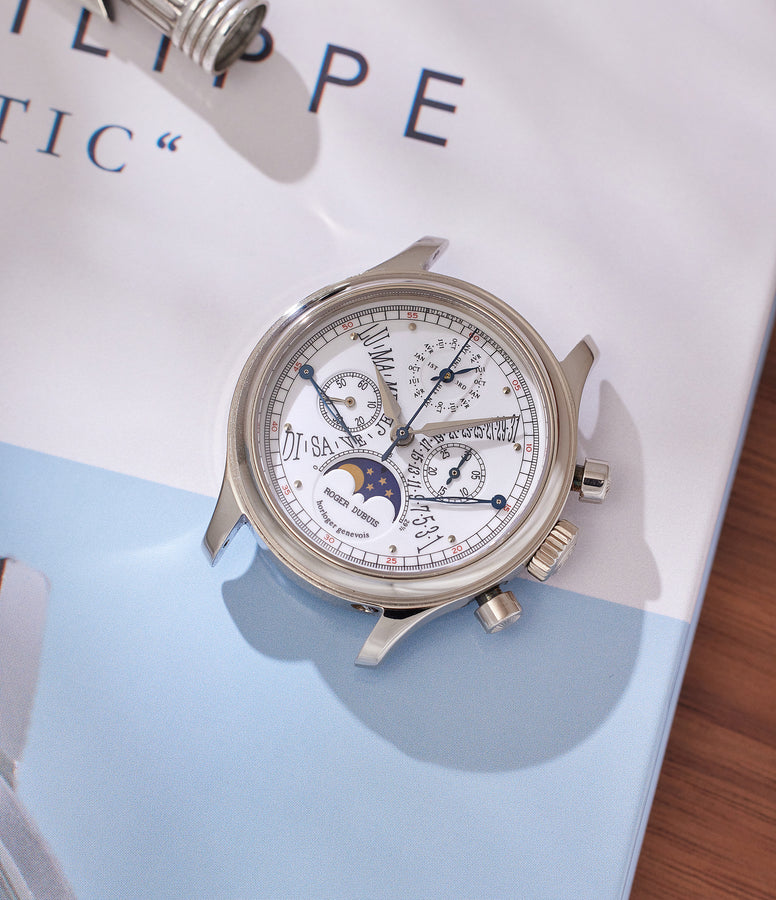
The history of Roger Dubuis is rich and complex, as Dubuis started his career in the 1950s working for Longines, before moving on to Patek Philippe’s complications department. From there he went his own way, starting his workshop in the ‘80s. Later on, in 1995, Dubuis would launch his eponymous brand driven by businessman Carlos Dias. Dubuis' chronographs typically appear in three sizes: 34, 37 and 40mm. This 37mm example represents a happy medium between vintage and modern sizings.
The first Roger Dubuis pieces were acclaimed by collectors because they channelled the traditional Genevan watchmaking that Patek Philippe embodied, paired with the watchmaker's signature stylistic flair. Dubuis inspiration was obvious in some of his choices, from seeking the Geneva Seal for his movements to his design of deployant buckles. The Hommage watches, as the name suggests, were a tribute to the great watchmakers of old, according to Dubuis. In 2003, after only eight years, the watchmaker left his eponymous brand. Though his output from these earliest days was limited, the design and quality of the pieces he produced have stood the test of time.
According to Dias, the initial intention was to actually limit each Hommage series to 25. Following the suggestion of a collector based in Asia, where the number eight is considered to bring good luck, Dias decided to limit each variant to 28 pieces instead.
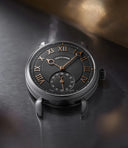
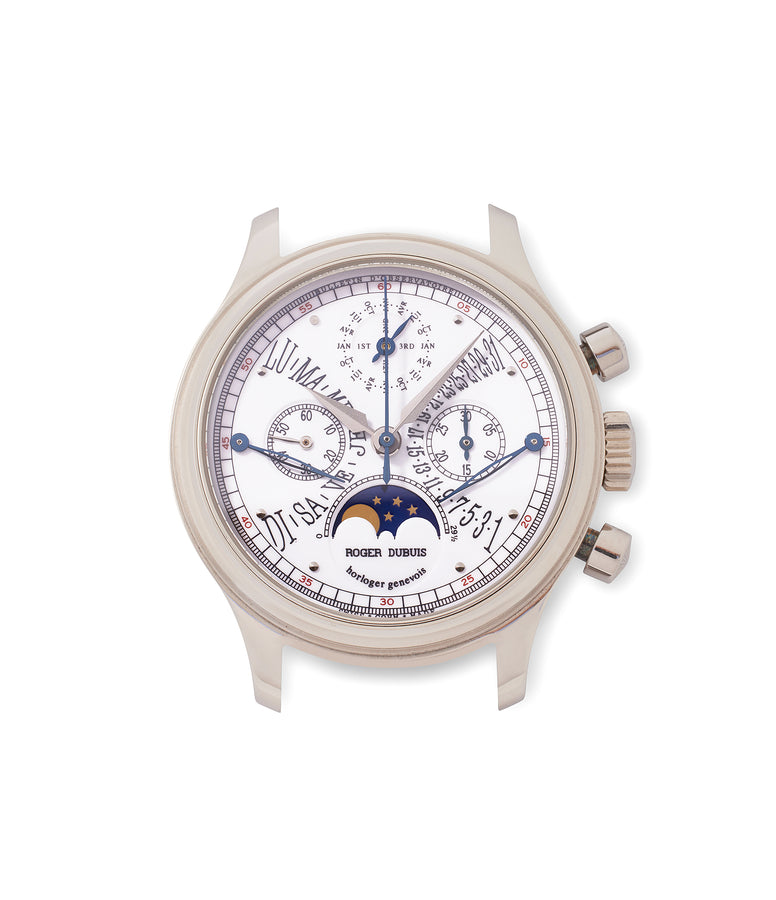
This Hommage Chronograph H37 is an interesting example. The case has developed an iridescent oxidised touch on the right side of the case, which has a purplish sheen that shifts to blue-green in the light. The overall effect gives the appearance the watch is cast in shadow on one side, and provides an unusual touch. More typical oxidation is found across the rest of the case and the dial, giving the watch a harmonious vintage look with the overall design language.
The concave bezel of the H37 has a subtle stepped detail and tips its hat to chronographs produced in the 1940s and ‘50s. This section meets a satinated midcase from which the lugs flow out. The lugs are satinated in profile and polished up top. The midcase is also home to the chronograph pusher that are are designed to bring to mind the iconic Patek Philippe ref. 1463 ‘Tasti Tondi’. The crown is large and signed. The screwed down exhibition caseback has a polished rim that bears deep engravings detailing the brand mark and the place of origin – Geneva. The backs of the lugs are home to precious metal hallmarks.
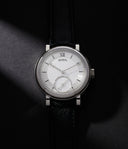
The white dial features a pulsometer scale, while the chronograph sub-dials have polished silver surfaces with numerals printed in black. The 12 and 6 o'clock markers feature applied numerals, with the other hour indications represented by black lines. The feuille-style hour and minute hands are rendered in white gold, with a blued seconds hand giving a touch of colour to the otherwise monochromatic dial.
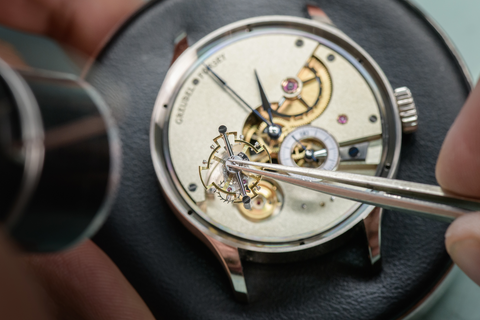
The watch is powered by the Calibre RD 56, based on the Lemania 2310, visible through the caseback. Likely regulated by Dubuis himself, it is finished to a standard befitting the Geneva Seal it wears. It is a 21-jewel straight-line lever escapement, a monometallic balance adjusted to five positions, a self-compensating Breguet spring, and a swan-neck micrometer regulator. As indicated by the "Bulletin d'Observatoire" signature on the dial, this movement was tested for accuracy at the Besançon Observatory, which famously set far more exacting standards than the Contrôle Officiel Suisse des Chronomètres (COSC).
The watch is powered by the Calibre RD 56, based on the Lemania 2310, much like the Patek Philippe ref. 5070. The movement bears the Seal of Geneva. At the time of production, it was only Patek Philippe movements that carried the Geneva Seal, hence why Dubuis felt that it was crucial to have the same hallmark of quality. The seal focuses on the art of decorating a movement with finesse and skill, in the style of Genevan watchmaking.
The complexity of the movement is revealed through an engraved sapphire case-back, featuring a 21 jewel, straight-line lever escapement, a monometallic balance adjusted to 5 positions, a self-compensating Breguet spring and swan-neck micrometer regulator. As indicated by the "Bulletin d'Observatoire" signature on the dial, this movement was tested for accuracy at the Besançon Observatory, setting far more exacting standards than a test from the Contrôle Officiel Suisse des Chronomètres (COSC).
If sold within the United Kingdom, this Roger Dubuis H37 560 will be subject to 20% VAT