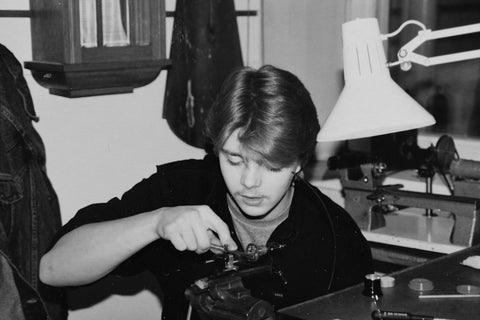
Kari Voutilainen followed the tried-and-true path for modern independent makers – learning his craft at the restoration house of Michel Parmigiani after being a student and later an instructor at Watchmakers of Switzerland Training and Educational Program (WOSTEP). The completeness of his skill as a watchmaker was suited to a career as an independent watchmaker, a path he has continued on with a degree of success seldom seen in this segment of the market. His operation now includes both a specialist dial and guillochage concerns in addition to the workshop in Môtiers.
While the watchmaker initially came to be known for his Observatoire, built around a batch of vintage Peseux 260 calibres, in 2011 he offered the Vingt-8. The new watch was powered by the proprietary calibre 28 featuring Voutilainen’s double-wheel take on Breguet’s natural escapement. The reference and the in-house calibre went on to become the backbone of his catalogue of offerings.
Complicated calibre 28
A couple of years after the Vingt-8, Voutilainen released the first complicated version of the calibre 28 – it added an eminently useful power reserve indicator to the manually wound context. However, instead of simply adding the complication modularly, Voutilainen extensively reworked it to include a few additional refinements.
The wheel linking the power reserve system to the mainspring is clearly visible on the movement side. Underneath the wheel lies a rotating differential cone, linked to a feeler arm – as the cone rotates as the mainspring is wound up or winds down, it moves the arm up or down, displaying the reserve on the dial side. It is a considerably more complicated setup than most and was designed with a view to more accurately reflecting the reserve in the mainspring.
While the Vingt-8’s mainspring offers 65 hours of reserve, it is down to 49 hours in the reworked calibre. This is achieved by means of a Maltese cross stop-work on the barrel. It was included with a view to using the section of the mainspring with torque best suited to chronometric performance.
Another refinement is the inclusion of hacking seconds. That Voutilainen had to redesign this part is visible in the off-centre position of the balance on the bar-style balance bridge.
The movement features a free-sprung balance with Breguet overcoil, a Grossmann interior curve, and direct impulse escapement with twin escape wheels.
It is extensively hand finished. The plates are decorated with frosting, while the visible wheels wear a range of finishes – from black polishing to radial brushing. The edges of the bridges feature anglage and the balance is beautifully black polished. The calibre is multi-layered in its arrangement, something that gives it visual depth. Screwed-on plaques detail the brand mark as well as the movement serial number.
The case
The Vingt-8R was created in a limited series of 25 pieces. On release in 2013, the watch won the Grand Prix d’Horlogerie de Genève (GPHG) Men’s Watch prize.
This example features a case crafted from white gold. It measures 39mm across and stands 11.5mm tall. It features a three-part case construction – the rounded dial- and movement-side bezels meet the midcase in prominent lips. All parts of the case are polished, save for the rim of the display caseback, which wears circular satination.
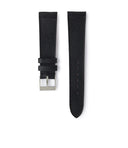
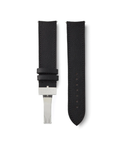
The midcase is home to the brand’s signature teardrop-shaped lugs as well as the well-proportioned, knurled crown. The watch is furnished with a black, large-grain, padded strap secured by a white gold pin buckle.
The dial
The richly adorned gold dial brings warmth to the white gold context. The outer brushed minutes chapter is punctuated with printed white minute plots and applied plots at 3, 6, 9 and 12 o’clock. Further in, set against a clous de Paris backdrop, is a quarter chapter of applied Arabic hours, interspersed with hash-style applied hour markers. A similar pattern, albeit on a smaller scale, adorns the inner portion of the subsidiary seconds register. The centre of the dial features a wave pattern of engine turning while the up-down power reserve indicator is set against a roseate pattern emanating from 2 o’clock.
While engine turning has long been a signature of Voutilainen’s work, the canvas for the craft is extended here. The result is quite stunning.
The hands, with the blue observatoire inserts and bases, stand in contrast against the warm dial. The seconds indicator is a simple pointer with a blued base.
The context
As the first complicated reimagining of the calibre 28, the Vingt-8R is both an important and exceedingly finite reference. It references horological history while thoroughly re-engineering the mechanics that underpin it. In white gold, with a warm dial, it is both classical and fresh. The watch wears its duality with poise.