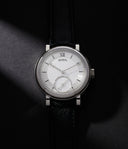
The reference 5074 Perpetual Calendar Minute Repeater was created in 2001 as a successor to the reference 3974. The outgoing historic reference featured a 36mm case designed by legendary maker Jean-Pierre Hagmann and the self-winding micro-rotor calibre R27Q with a minute repeater complication. It was, at the time it was released in 1989 to celebrate the brand’s 150th year, the most complicated Patek Philippe wristwatch. Around 120 examples of the 3974 were created till 2001.
So the 5074 had a lot to live up to. Imagined as a perpetual calendar minute repeater for modernity, it was originally released in yellow gold, followed by a rose gold variant in 2005. The reference was eventually cased in platinum starting in 2009. Of the metals, the fewest numbers were created in platinum and these are rightly viewed as the ultimate configuration of the 5074.
The case
The case bears much in common with the reference 5070 in size as well as details, which in turn draws lineage from the 46mm-wide reference 2512, a unique split-second chronograph Patek Philippe created in the early 1950s. Notably, the 5070 – first seen in 1998 – was the brand’s first serially produced reference to feature a case larger than 40mm.
The 5074 followed closely in this tradition. It features a double-stepped bezel, with a gently cambered part giving way to a lip that meets the gently domed crystal; the snap-on, display caseback features a similarly cambered bezel. The midcase is rounded with a small recess for the knurled and signed crown. On the left flank, integrated into a horizontally satinated recess, lies the integrated slider for the minute repeater. Four correctors – one at 10 o’clock, two in between the top lugs and one between the bottom lugs – help manipulate the perpetual calendar. As is customary of modern platinum-cased Patek Philippes, a brilliant cut 0.02 carat Top Wesselton diamond is set into the midcase between the bottom lugs. The watch comes with an additional closed platinum caseback.
The stepped bezel details serve to lighten the 12.5mm case height. The lugs, that curve down sharply and terminate in flat ends, are also visually consistent with the bezels – they feature a sharp stepped facet. Engravings detailing the brand mark and precious metal hallmarks are reserved for the underside of the lugs.
The lugs stand 21mm apart and come furnished with a black, large-grained leather strap secured by a platinum pin buckle.
The dial
Here too the black dial of the 5074P-001 displays its 5070 lineage. On the outside run a white printed chapter of chemin de fer minutes, with Arabic markers at intervals of five. Further in is the applied white gold chapter of Arabic hours, like on the 5070. The two sunken calendar registers at 3 and 9 o’clock have a white gold bezels. A similar, but partial bezel is also found on the moonphase register at 6 o’clock.
Each register expresses two units of time – the one at 9 displays both the day as well as the time on a 24 hour scale; the one at 3 o’clock expresses the month and the leap year; the 6 o’clock register shows the moonphase and the date. All calendar scales are printed in white. The white gold hands are feuille-style and polished, save for the ones plying the 24-hour time display and the leap year indicator – since these are co-axially mounted with a hand displaying another unit, they are painted white to visually distinguish them.
The cathedral chime
As noted previously, the 5074 shares the calibre R27Q with its predecessor, the reference 3974. The movement, which is 28mm across and stands just 6.8mm tall, is a micro-rotor self-winding calibre. The movement uses a monometallic Gyromax free-sprung balance wheel that beats at 21,600 vibrations per hour (3Hz). It is adjusted to five positions, the chronometric standard.
Its bridges are adorned with Côtes de Genève with the edges bevelled and polished. The solid gold uni-directional winding micro-rotor is crafted from solid gold and finished in a barleycorn pattern. The single mainspring barrel offers up to 48 hours of reserve. It is adorned with the Patek Philippe seal which the historic house transitioned to, replacing the Geneva seal, also starting incidentally in 2009.
While the adornment is superlative, the main attraction here is the minute repeater complication. It features a traditional twin-hammer arrangement. However, to achieve the signature cathedral-style chime, the gongs encircle the calibre one and a half times, as opposed to just the one time like in most minute repeaters – the additional length of the hammer produces a booming sound signature, akin to the sound of ringing church bells bouncing off the vaulted ceilings and seeping through thick stone walls.
The cathedral sonnerie emanating from the dense platinum case has a similar quality. It is both loud and pleasing, precise yet melodious.
The stainless-steel hammers are black polished and their edges bevelled to sharp points, and mirror polished. A gold Calatrava grille sits atop the centrifugal regulator that determines the rate at which the hammers strike the gongs.
This examples of the 5074P-001 comes with its full set of outer and inner boxes as well as all literature, including retail paperwork from the Geneva boutique from 2015.
In context
The Perpetual Calendar Minute Repeater reference 5074P-001 presents some of the most venerated traditions of classical watchmaking. However, it does not feel alien to the modern context it is presented in, which is testament to Patek Philippe being both true custodians of the heritage and fine current practitioners.