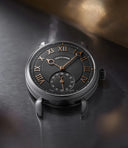
The Anywhere is the successor of the Everywhere, and was the second watch released by Krayon. This example is the warmer, rose-gold counterpart to the original watch, which featured cooler shades of dark and light blues. The rose-gold piece invokes the feeling of sunsets and the softer glows of dawn, complementing the spirit and intention behind the watch.
The outer chapter ring features a textured light gold section and deeper navy section flecked with stars, representing day and night time respectively. A polished, hand-engraved sun symbol tracks the progression of the sun in the sky, in the same golden appearance as the triangular facet indices and hands, with a peripheral ring marking the hours in Arabic numerals. The centre of the dial features a motif of spherical lines that are shared across the other Anywhere pieces. A silvered sub-dial contains information about the date and month. Meanwhile, the midday, midnight, 6am, 6pm, and quarterly month indications are written out in black text, breaking up the numerals for greater clarity.
The movement of the Krayon base calibre, which is used in both the Anywhere and the earlier Everywhere, took Maillat – who has an engineering as well as watchmaking background – almost two years to develop. A new gear train, lever escapement, and balance had to be created from scratch for the calibre, while the design of the movement allows them to incorporate a complication on the same level as the gear train, without adding any further thickness through the usual method of incorporating a module on top.
Because the Anywhere and Everywhere pieces are built on very similar foundations, it would be a disservice to call the Anywhere a simplified version, given the immense amount of work that has gone into the movement. Rather, this is a streamlined example that is easier to read, with an elegantly designed dial where the complications are discreetly integrated in the outermost section and sub-dial. The focal point of the Anywhere is that it can show the wearer the precise time of sunrise and sunset of a single given location. This complex calculation has to take into account several factors, including the timezone, latitude and longitude, as well as date (time of year), and the equation of time (the offset between mean time and solar time). Krayon have obtained three patents for various innovations that the watch puts forth.
The main difference between the Anywhere and the Everywhere lies in how the mechanism can be adjusted. With the Anywhere, the setting can be changed by a watchmaker, via a micrometer screw attached to the cams that control its "eccentricity" – the position of the cam relative to its area of movement. Furthermore, there are correction screws attached to bridges on either side of the cam that also help in adjusting the sunrise and sunset times. Consisting of 432 parts, the watch is impressively complex, with its finishing and design just as admirable as its mechanisms.
The rose-gold case of this watch is a classical choice, complementing the sandy tones of the dial. The fluted lugs taper downwards and are soldered to the case, giving it a fairly traditional look. It has a mirror-polished finish throughout, also a nice touch that mirrors the sun symbol travelling around the dial.
Turning the watch over, we can view the movement through the sapphire caseback. It is beautifully decorated with anglage throughout, as well as their signature curved Geneva stripes – a particularly difficult feat, given the irregularities of the pattern. When viewed as a whole, the shape that their finishing takes is the sunset time of Neuchâtel over an entire year, while the shape of the bridge itself is based on Lake Neuchâtel. Maillat describes the process of creating these stripes: “We put the data into an Excel table and used the file’s parameters to define the Geneva stripes, as well as the rotation. Essentially, a cylindrical tool is used to create Côtes de Genève, moving across the surface of the bridge to create the shape. So, what you see visually is the diameter of the tool, combined with rotation and movement. This is combined with the angle of the tool as it touches the bridge.”