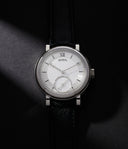
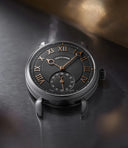
The 1941 Grönograaf was released in 2022 and is notable as the first chronograph created by the Grönefeld brothers. The brothers are known for their ability with complications honed at the famed specialist movement manufacture Renaud et Papi. From the independent workshop in Oldenzaal, Netherlands, Grönefeld has created watches with complications such as remontoires, tourbillon minute repeaters, and deadbeat seconds. The addition of a manually wound chronograph, a time-honoured complication, marked another step towards creating a more complete offering. In keeping with the brand’s practice of grounding each reference in the history of the Grönefeld family, the chronograph is part of the 1941 series, a reference to their father’s birth year. The 1941 Grönograaf will in a series of 188 pieces in stainless-steel, with an additional 25 examples cased in tantalum.
The story of this reference must begin on the movement side. It is an entirely novel calibre and replaces some of the harsher interactions typical of the reset function of chronographs with an arrangement that is markedly more controlled and softer. The calibre G-04 employs a traditional lateral clutch arrangement and column wheel coupling mechanism. However, it employs a centrifugal governor for the reset function – such a device is typically used to control the chiming frequency of minute repeaters.
The reset is usually a robust interaction, with the force required to bring the chronograph seconds hand back to the zero-position coming up against the proverbial wall of the final resting position. The force expended when the chronographs seconds hand is brought to a dead stop reverberates through the hand. This is neither mechanically efficient nor ideal for watch's longevity. In the calibre G-04, a centrifugal governor is deployed to manage this reset – on the dial side it returns the chronograph seconds hand to the zero position in a smooth, gliding manner. In the Grönograaf, this centrifugal governor, with twin gold weights, is visible on the dial side just below 3 o’clock. On the movement side, the governor manages the action of the twin-armed hammer that resets both the chronograph seconds as well as the 30-minute elapsed time register by means of heart-shaped cams – just like the chronograph seconds hand, the centrifugal governor returns this hammer to the reset position in a distinctly placid fashion.
Another point where gentler interaction comes into play is the one between the hammer and the heart-shaped reset cams previously mentioned. Instead of the typical steel-on-steel interaction and the sliding friction that comes from such an interaction, the twin hammer ends in the G-04 are fitted with ruby rollers. When the chronograph is reset, these descend on the heart-shaped cams, gently pressing them into the reset position. These refinements reflect the watchmakers’ mechanical skill and are equal to the high contemporary standards of fine, artisanal watchmaking.
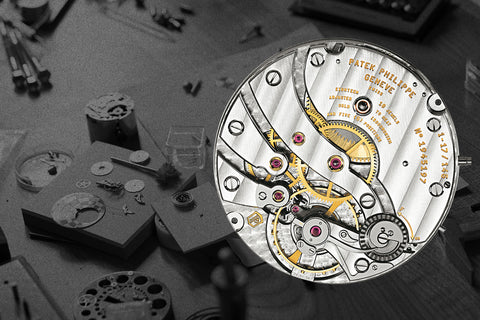
Superficially, the calibre G-04 is visually consistent with other calibres of the Grönefeld family – the stainless-steel bridges, mirroring bell gable roofs of Dutch houses, wear micro-blasting in the centre, with raised, hand-bevelled edges. It is richly decorated, with jewels outfitted with gold chatons and relief engraving referencing the jewel count (45) and the brand mark. The impossibly thin arms of the skeletonised bat-wing-shaped balance bridge feature polished, bevelled edges. The flat heads of the screws are black polished. The calibre number is engraved in gold and is visible under the balance wheel. The baseplate is decorated with perlage.
Layered on top are the levers and architecture of the chronograph. A long, black polished bar bridge anchors both the central wheel and the wheel of the 30-minutes elapsed time register. The column wheel is brushed in profile and black polished on top. Both the heart-shaped cams are also finely black polished.
The stainless-steel case has all of the complexity of form of the 1941 line. It is cleverly designed to minimise its footprint. This is evident in the concave form of the bezel, as well as the flowing, stepped shape of the short but substantial lugs. This sculpting is evident even in profile where the concave form of the bezels serves to create an impression smaller than the 40mm diameter and 11.3mm case thickness would suggest. The lugs, 20mm apart, are fitted with a fresh grey, alligator-grained leather strap bolstered with a lightweight cork lining. It is secured with a signed stainless-steel pin buckle. The crown, shaped like a jet exhaust, is fluted to aid ergonomics while the chronograph pushers are squared with a bulbous lip at the top.
The dial revels in its three-dimensionality. On the outside runs a black printed chronograph seconds chapter printed on a white base. Further in lies the sunken, frosted grey dial with relief-style brand mark and place of origin at along the bottom arch of the dial. The regulator layout is well judged, and the four decentralised displays (plus the centrifugal governor) are built up on raised plinths. The time display sits at 1 o'clock, with a small seconds at 9, and 30-minute chronograph counter at 6. This last register is self-engraved with the serial number out of 188 as well as the name of the reference. The large blued central chronograph hand features a long counterbalance with an open aperture that perfectly overlaps the hand plying the 30-minute chronograph register. Moreover, visible through the open apertures on the counterbalance of both these hands is a finely black polished screw. This is perhaps one of the most understated examples of the design thought evident throughout the Grönograaf.
The raised plinths the displays are placed on are faceted and polished with this form and finish repeated again around the central sunken frosted portion of the time display. The applied hour markers are beautifully faceted and polished. The 53 hours of reserve are displayed on a scientific-looking arched display plied by a mystery pointer. The combination of finishes on the dial, together with the blued hands, with a hint of gold in the centrifugal governor, helps the dial glimmer as brightly as the finely crafted case. That it manages such lustre from stainless-steel is remarkable.
On its release the 1941 Grönograaf represented something of a rarity – a truly high horology chronograph made entirely in-house by an independent. Grönefeld so deftly balances innovative mechanics with its signature aesthetic that makes the Grönograaf a real triumph. This is an early and fine example of this modern classic.