








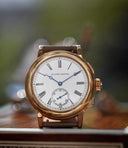
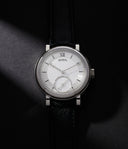
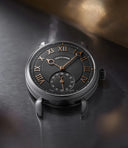


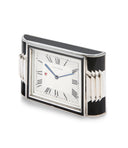


This is one of 6 examples of the John Shaeffer reference 25839* with a 33.5mm platinum case designed by Jacqueline Dimier. Created for a single year between 1996 and 1997, this reference with a total production of just 18 pieces really was a brief and distinct moment in time. The other 12 examples of the reference were crafted in yellow and rose gold. It features a jump hour display paired with a regulator-style minutes indication. At its heart lies the manually wound minute repeater calibre 2865, designed and created by famed specialists Renaud et Papi.
The essence
The short-lived line, which was launched in the early 1990s and was discontinued before the end of the decade, traces its history back to a single minute repeater housed in a pendant watch with a coussin tortue-shaped, platinum and yellow gold case.
Sold initially in 1908, it was brought back to Audemars Piguet in 1923 to be transformed into a wristwatch, as was quite common in the era. The piece featured a yellow-gold repeater slide and caseback. The watch face was made from platinum and when Audemars Piguet added lugs in 1923, these were also made from the same precious metal. The watchmakers would see the piece again in 1927 when it came back to Le Brassus from the United States, this time because the owner at the time wanted to personalise it. But instead of just engraving the caseback with his initials (something the owner also did, by the way), he wanted the watch face to bear his mark too. The owner, John W. Shaeffer, was the vice-chairman of the Allied Chemical and Dye Corporation, an influential company that counted the automotive, oil and gas, and chemicals sectors as its clients. Shaeffer had noticed that he had 12 letters in his first and last name, exactly the number of markers on a watch face. So at his unusual request, Audemars Piguet replaced the hour markers with the letters of his name and this is how the mythical John Shaeffer watch was born.


According to the brand, when it acquired this historic piece and exhibited it at the original iteration of its museum in 1992, it garnered such a reaction from enthusiasts as well as its own watch designers that the decision was made to spin it off into a whole new line. This resulted in 1995 in the John Shaeffer Collection. The watches, available in an array of dial options and complications, featured a square, 33mm cushion case in precious metals such as platinum and yellow or rose gold. Powering the watches were manually wound calibres, finished to a high degree and visible through exhibition caseback. While the case closely resembled the original, a few design flourishes, such as a stepped bezel, were added. The other thing that all the iterations had in common was that they were made in very small numbers. Many of them featured minute repeater complications.
In its simplest form, a John Shaeffer could be had as an uncomplicated three-hander (with a sub-seconds’ register) with traditional, printed numerals. Some with a similar dial layout incorporated a minute repeater, while other examples could be had with a triple-date and moonphase complication. A few examples had open-face dials, while others featured jump-hour displays.