The story
Created in fits and starts between 2002 till 2008, it is understood that no more than 225 examples of the Lange 1 reference 101.027X were ever created.
The dial colourway, the reference’s key detail, is believed to be influenced by Loschwitz Bridge over the river Elbe in the Saxon capital of Dresden. The historic riverine region was briefly a UNESCO World Heritage site. A. Lange & Söhne created the 101.027X by taking inspiration from the bridge, often referred to as the ‘Blaues Wunder’ (Blue Wonder) because of its original colour. The story goes that when UNESCO rescinded the status a few years later, the brand decided to keep the reference 101.027X off its official catalogue and offer it to a select number of boutiques to sell on privately.
Consequently, the reference attained an aura of mystique that remains to this day. The X in the reference number is a nod to this special status. The brand often employs this nomenclature to mark an extraordinary detail in a reference.
The inspiration
Ever since its relaunch in 1994, A. Lange & Söhne watches have almost exclusively been crafted from precious metals. It has been a point of both principle and pride.
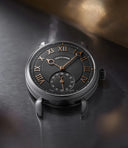
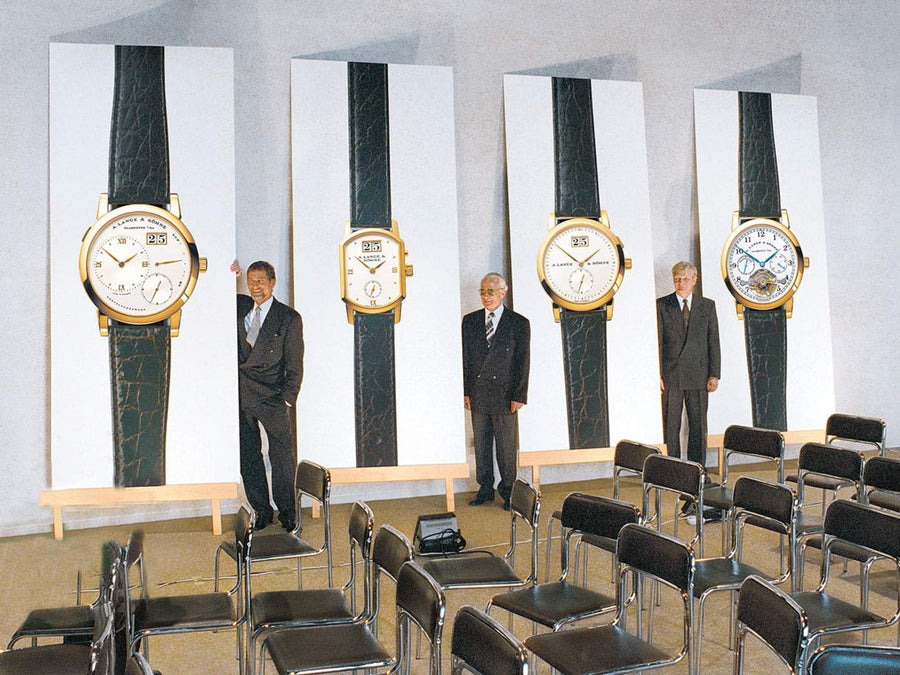
However, in the early days, the brand occasionally deviated from this formula, creating unique stainless-steel examples of watches such as Tourbillon Pour Le Mérite as well as small series of the Lange 1 in this metal. The latter is most relevant to this conversation since the reference 101.027X bears visual lineage from a dial fitted to one such stainless-steel iteration. In fact, the stainless-steel Lange 1, designated reference 101.026 – specifically the one created with pearlescent white dials, printed indices and blued hands – is visually indistinguishable to the reference 101.027X. The proximity of their reference numbers is another clue to the lineage.
The white dial 101.026 (there was also a black dial iteration in stainless-steel with traditional applied indices) and the 101.027X offer the most contemporary re-imagining of the now well-established Lange 1 aesthetic. The 101.027X marries this quality with a more traditional, white gold case.
The dial and case
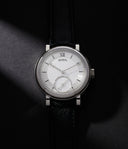
The decentralised time display that is elemental to the Lange 1 is home to much of what differentiates the reference 101.027X. This register is finished with closely packed concentric rings and a quarter of Roman numerals interspersed with diamond-shaped hour markers and a chapter of minutes, all printed in black. The marginally overlapping subsidiary seconds register also has a similar base and a black printed sector-style chapter.
At 3 o’clock is the ‘up-down’ power reserve indicator. The slim, blued alpha-style seconds hand is complemented by the similarly formed indicators for the hours, minutes and power reserve displays. The panoramic date, framed by a white gold window, is believed to be inspired by the Five-Minute Clock at Semper Opera House in Dresden.
The rest of the dial further underlines the masterful use of negative space, furnished only with the brand mark at 12 o’clock, the country of origin printed prominently underneath the time display and the ‘Doppelfederhaus’ mark running along the arc of the bottom half. It is worth noting the small print ‘Made in Germany’, an early trait of the Lange 1.
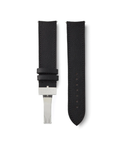
The three-part white gold case appears as an extension of the cool white dial. The case features a high-polished bezel with the caseback’s faceted edge featuring a similar finish. This detail of the caseback gives way to a brushed rim that contains the display caseback. In between the screws that secure the caseback are engraved details such as the brand and Glashütte marks as well as the hallmarks of the precious metal of the case and the casemaker. The satinated midcase features a squared pusher adjuster to quickset the date and is also the source of the stepped lugs that gently curve down. The lugs, stepped from the case and 20mm apart, wear polished finishing. They wear a black large-grained leather strap with a signed white gold deployant clasp.
The movement
Underpinning the aesthetic is the manual-winding calibre L901.0, offering 72 hours of autonomy. The watch has a lever escapement and the balance beats at 21,600 A/h. In true A. Lange & Söhne style, the impressively finished movement, with its dominant three-quarter plate decorated with Glashütte ribbing features chamfering and anglage done by hand. The visible working jewels are ensconced in gold chatons while all visible screws are heat-hued to a vibrant blue. The bridges and plates are crafted from German silver, while the balance cock features intricate hand-engraving. Both are signature elements of A. Lange & Söhne.
The watch comes with a recent certificate of origin from the brand.
The significance
The 101.027X is proof positive that the Lange 1 aesthetic is both timeless and versatile. The off-catalogue reference represents a moment when the brand was more amenable to creating pieces based on popular demands.