DIAL
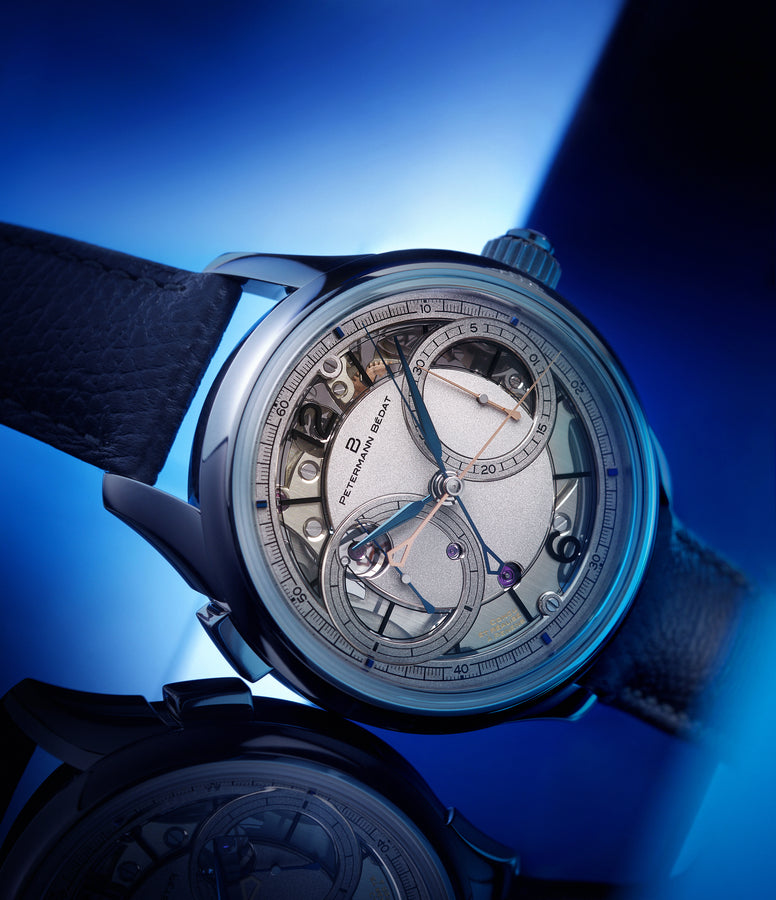
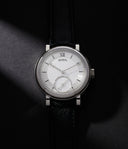
Considering the watch’s overall design, we see that Reference 1825 leans on historical references, as the pair look towards the past to inspire and challenge their own work. While their first two watches featured a more sculptural, openworked approach, the closed dial of the Reference 1825 is a source of intrigue, acting to complement the complex movement design as well as a masterful demonstration of thoughtful craft and process.
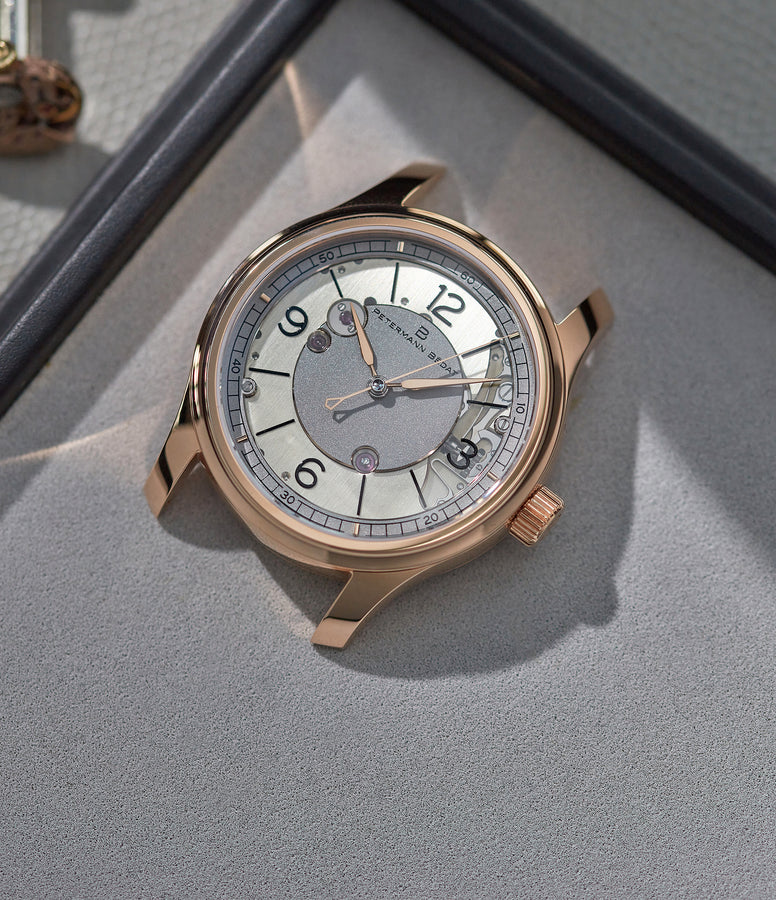
The dial itself consists of several layers. The base plate of the dial is in white gold. Meanwhile, the construction of the base plate itself features a raised outline encircling the centre of the dial and the sub-dial, respectively. These act as borders for the enamelling step of the process, in a style close to champlevé enamelling.
But before the enamel is applied, the dial is laser-engraved with different densities – less densely on the outer section of the dial and more densely on the central section, with this slight difference providing the appearance of lighter and darker grey shades respectively through the varying reflection of light. Overall, this produces a kind of two-tone effect that further brings to mind the watch’s vintage inspirations, with particular reference to pocket watches of the 20th century.
A layer of transparent grey grand feu enamel is laid over this textured surface, filling each of the sections created at the base plate stage, and making a glassy appearance in the light. Printing comes next, with the Petermann Bédat logo and name, then the application of the diamond baton markers. The final stage involves the placement of the minute track on the outermost section of the dial, as well as the applied, unobtrusive rectangular indices at each 5 minute mark.
These invocations of the past inform their work but are crucially not imitations — acting more as tributes. Bédat adds, “A lot of the pocketwatches in our books have very interesting shapes that we don’t see a lot today. We always turn to the books to see what was done and how we can bring that into the modern era.
MOVEMENT
When faced with designing the new movement for the Reference 1825, the pair asked themselves: how to make it uniquely Petermann Bédat?
As Petermann mentions, “For us, it’s very important to have our own identity, in terms of the movement. With the deadbeat seconds, we tried to create something different, with the complication. Then when it came to the chronograph, I think we developed a real identity. So, after that, we said we need to keep this — but what exactly is our identity? We are not a brand that shows all the components. We know we like pocket watches. Ultimately, we need to find our own way to show things.”
In this way, the time-only piece grew from a single idea, fusing their love of pocket watches with their past work. A shared feature of many pocket watches is the isolated small bridge used for the crown wheel, which, for many modern watches today manifests as a single bridge for both the barrel and crown wheel. This seed became a key detail around which the pair constructed the rest of the movement. Additionally, steel bridges can be found in both their 1967 Deadbeat Seconds and 2941 Chronograph, and Petermann and Bédat were determined to integrate this within the Reference 1825.
A breaking point came in their original decision to depart from tradition and create a symmetrical movement. However, this didn’t feel right for several reasons. As Bédat mentions, “in the symmetrical version, we removed the swan-neck system, and for me that was quite a shame, but we had to do that because it was symmetrical. That’s one of the reasons I asked Gaël to change the design, because I believe [the swan-neck system] is something we need to keep on all our watches.”
CASE
The case of this Reference 1825 is crafted from tantalum, a rare, dark-grey precious metal that is tricky to shape. The shape of the case builds on the shape of the previous Reference 2941. A sleeker iteration of their previous work, the case is just 38mm in diameter, straddling modern and traditional sizing, and is also only 10.15mm in thickness, including the crystal.
OUR STORY
Our admiration for Petermann Bédat stretches back to the brand’s inception, intrigued by their vision and interpretation of their influences. Over the years, their work has only grown from strength to strength, mirroring the rapid expansion of the independent industry. This third piece ushers in a new stage of their work, building on two technically strong pieces to further assert their aesthetic philosophy.
A Collected Man is an authorised retailer for Petermann Bédat. If you would like to express your interest in the Reference 1825, please get in touch with one of our specialists.
If sold within the United Kingdom, this Petermann Bédat 1825 will be subject to 20% VAT