In 1959, Patek Philippe obtained a patent for Louis Cottier's world time complication, with the manufacture since having become synonymous with the complication. In 1953 it released the reference 2523, which has since taken its place – alongside hallowed perpetual calendar chronograph references such as the 2499 and 3970 – one as one of the most iconic from the brand.
The reference 5131P carries forward the legacy of the 2523 – while imbued with a similar philosophy, it is thoroughly modern in every conceivable way. To those predisposed to such historic references, the 5131P was the logical progression of the brand’s story.
It is fitting then that the brand chose to mark its 150th year in 2014 with two references featuring the same complication. The first was the 7175R-001 in red gold and a diamond bezel aimed at a female clientele. The second, seen here, was the World Time Moon reference 5575G-001. It was produced in a series of 1,300 pieces.
Under 40mm across and standing under 10mm tall, its case is unique to the anniversary reference and the white gold it is crafted from isn’t coated in rhodium as is often the practice to give the metal it’s signature shade. Its modern dimensions are creased by a historical perspective, and consequently the 5575G-001 keeps one foot firmly in the realm of classicality.
The concave bezel rises from a vertical faceted base to a flat facet where it meets the sapphire crystal. The midcase has dual aspects – it follows the camber of the bezel, rising to a ridge in the central portion. From there, it slopes down to the closed caseback. The midcase ridge flows like a wave, continuing in the facet on the lyre-style lugs. The ridge is home to both the knurled crown at 3 o’clock as well as the squared pusher for the world time at 10. In fact, the pusher too follows the wave-like form of the midcase ridge.
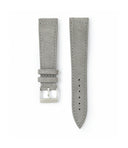
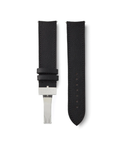
The lugs are 21mm apart and are furnished with a grey, wide grained, alligator-style leather strap secured by a white gold deployant clasp with the Calatrava cross, the brand mark as well as the period ‘1839-2014’ that the piece commemorates. The underside of the lugs bear the hallmarks of the brand and the precious metal the case is crafted from.
The dark anthracite dial features a rotating outer disk graduated with two rows of 24 cities marking the time zones, pad printed in white for maximum contrast. It is worth noting that in these anniversary references, Paris is replaced with Geneva, the home of Patek Philippe. This is followed by a rotating day/night disk with the 24-hour scale.
Framed by a raised chapter with applied hour plots, is the moonphase display. The piece of kinetic art is speckled with stars and has two layers to it – on the top is a stationary heart-shaped translucent sapphire disk with the brand mark; underneath it lies the rotating moonphase.
Manipulated with a corrector at 2 o’clock, it features an almost holographic moon with a photo-real representation of the lunar surface. The hours hand is inspired by the Southern Cross and is skeletonised while the minutes hand is lancet-style. Both are crafted from white gold and faceted to play with light.
Setting the watch requires lining up the current time zone at the 12 o’clock position and adjusting the time using the crown. From then on, engaging the pusher advances both the 24-city reference ring as well as the hours hand in one-hour increments, quickly adjusting to a new time zone while also correctly displaying the time around the world.
Obscured from view by the closed commemorative caseback, the watch is powered by the calibre 240 HU LU, which is a micro-rotor self-winding calibre offering 48 hours of autonomy. It features a free-sprung balance, with an anti-magnetic silicon hairspring. The movement beats at 21,600 vibrations per hour and is adjusted to six positions, one more than the chronometric standard. It is finely finished to the grade the brand is known for.
The watch comes with an extensive set of commemorative box and paperwork. This includes an armoire-style piano wood box with the anniversary date etched on the inside, as well as a letter signed by Philippe and Thierry Stern. The set also includes the original bill of sale and warranty details from 2015 in addition to the instruction manual.
The World Time Moon 5575G-001 is a vision of a future of Patek Philippe that could have been, one more tightly aligned to the brand’s history. However, it doesn’t rely solely on historic reverence, choosing to bring joy through an oversized moonphase complication that is pure kinetic art. That it exists at all is both a wonder and testament to the historic brand’s ability to continue to surprise.