Beat Haldimann draws from a long family history of watchmaking that stretches back to 1642. He established the modern branch of the family, Haldimann Horology, in 1991 and has since become synonymous with his innovations such as the first central flying tourbillon (in the H1), his attempt at harnessing resonance (in the H101 Regulator Resonance) and the first detached escapement, for which the brand holds the patent. Such progression of traditional mechanics is balanced with philosophical ruminations on the very idea of timekeeping, such as in the H9.
These innovations are all the more impressive given Haldimann’s stress on creating using only traditional methods and hand tools. He is joined today in his workshop in the Villa Nussbhül, on the banks of the River Aare in central Switzerland, by the next generation of Haldimanns – his daughter Iris Olga and his son Niklaus Anton. Together they are writing the next chapter of the family’s watchmaking story, while also honouring the past – Haldimann continues to restore and service all watches and clocks that bear the family name free of charge.
The H11
The H11, which was launched in 2013, is in some ways the simplest execution of Haldimann’s philosophy and aesthetic. In its most essential guise, it expresses just the hours and minutes. This simplicity hides unusual architecture – echoing the central flying tourbillon on the H1, the balance wheel on the H11’s calibre takes centre stage on the movement side. On release, it was the first wristwatch to feature such a detail. According to Haldimann, one face registers the passage of time, while the other is witness to the flow of it.
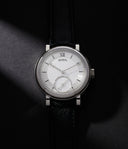
This is a recent example of the H11, benefiting from the independent maker’s continued improvement of their craft over the years. The case, created from stainless steel, measures 39mm across.
Crafted at Haldimann’s workshop, the case is simple and refined. A gently rounded bezel meets the subtly concave midcase in a small lip, with this detail repeated again on the caseback side. The onion crown is well proportioned and knurled to suit the task of manually winding the calibre. The straight lugs are soldered to the midcase, and are gently rounded at their ends. However, this last detail does not detract from the overall flatness of the case profile. Standing 10.8mm tall – and framed on the dial side by a gently domed sapphire crystal, and on the movement side by a flat one – the case sits very close to the wrist.
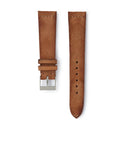
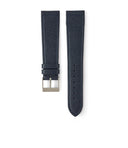
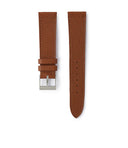
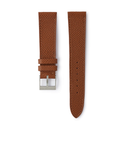
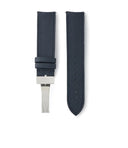
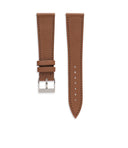
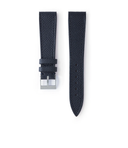
The lugs are 20mm apart and are furnished with a navy, large-grained leather strap secured by a signed pin buckle. The pin bars are of the screwed-on variety.
The dial and movement
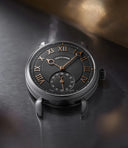
The prevailing air of simplicity of the H11 extends to the appearance on both dial and movement sides. The grené, or frosted dial is crafted on a silver base, coloured to a midnight shade created specifically for the stainless-steel H11. The Roman hours, minute and subsidiary seconds plots are engraved and filled with lacquer to ensure the longevity of the dial. The contrast of the silver numerals against the textured blue dial also aids legibility.
The delicate hands are crafted from stainless steel by artisans at Haldimann. They are topped with club-style apertures that are richly detailed despite their small scale. The subsidiary seconds hand is simple, with a rounded counterweight.
The differences
The movement view of the calibre Zen-H11 is dominated by a frosted full plate, lending visual continuity from the dial side. The plate is interrupted by apertures for the central balance wheel, as well as the crown and ratchet wheels. This late example benefits from finer details – the full plate has additional cut outs to expose part of the fourth and escape wheels. The edges of these cut outs on the plate are bevelled and polished. The raised, open-work balance bridge, held in place by a larger central screw, features fine brushing rather than the frosting found on older iterations of the same calibre.
The rapid to and fro of the golden balance wheel – moving at a rate of 21,600 vibrations per hour – with the flat balance spring breathing in and out within, and the rhythmic two-step of the pallet fork brings a kinetic element to the otherwise placid reference.
There are differences when it comes to the engravings too. While previously the brand mark and 12-plot logo was located just below the balance wheel, these etchings have been moved north of the balance wheel to expose the fourth and escape wheels. While in the past the movement side only featured hand etching detailing the reference and the year the watch was crafted, current versions also detail the calibre and serial numbers, the brand mark as well as the name of the watch.
The calibre Zen-H11 measures 31.6mm across, and the mainspring offers 38 hours of autonomy when fully wound.
This example of comes with its full set of warranty paperwork as well outer and inner boxes.
The H11, despite its relative newness, has taken its rightful place alongside some of the finest time-only references from modern independents. It is a sum of considered and finely executed details, yet no part of it feels overwrought or superfluous. That much of it is crafted traditionally at the Haldimann Horology manufacture makes the H11 that much more compelling than its contemporaries.