The Quantième Perpétuel was first announced in 2012. It carried on the trajectory that started with the twin-window day and month display of the Octa Calendrier, followed by the brand’s first perpetual calendar, the Octa Perpetuelle. The Quantième Perpétuel was one of the first of the generation of central dial layouts. When it was finally launched in 2015, it featured a clover-style polished steel ring at the centre of the dial, a detail that visually distinguished it.
This is an early example of the Black Label iteration of the Quantième Perpétuel, a reference that was produced in this configuration from 2016 till 2021. Black Label edition pieces are produced in limited numbers and made available only to existing clients of the brand through F. P. Journe boutiques around the world. Only a couple of the brand's references are picked every year to feature a small number of Black Label examples.
The year 2021 marked a change of the aesthetic of the Quantième Perpétuel, with the clover-style inner ring replaced by a clous de Paris-style decoration.
Black Label
In our view, the aesthetic of the Quantième Perpétuel is best suited to the Black Label name – the tuxedo, or black-tie colourway, rather than a full black dial, is an interesting detail. On the silvered outer edge runs a black printed chemin de fer track of minutes, followed by a full Arabic chapter of hours. The numerals have real volume to them, which together with the lustre of the print, makes them very attractive and three-dimensional.
Further in lies a clover-shaped, black polished stainless-steel frame which contains the black central portion of the dial and the calendar information. The balance of elements is noteworthy – the up-down 12-hours power reserve indication lies across from the brand mark at 3 o’clock; the twin windows of the day and month indications lie across from the double wheel date indication. To retain this symmetry, the leap year indicator is co-axially mounted with the minutes and hours hands at the centre of the dial.
All hands are polished stainless-steel, visually continuous with the clover-shaped frame. The printing in the central portion is white, save for the leap year, which is in red. The wheels of the calendar functions are also white with black printing.
Simplified complication
All functions save for the month, and the leap year indicator that is linked to it, is done via the crown. The coupled day and date functions can be manipulated by turning the crown clockwise; turning it counterclockwise helps set the day independently. Pulling the crown out one more position helps set the time.
Instead of employing a pusher or corrector, a small triangular lever is integrated into the top right lug. Pulling this out and pushing it down advances the months, and with them the leap year indicator. It goes to the watchmaker’s determination to not have correctors interrupting the form of the midcase.
An elegant case to go with an elegant complication
As is the formula for the Black Label references, the case is crafted from platinum and it is the more classically proportioned 40mm size, rather than the 42mm that the Quantième Perpétual was also available in.
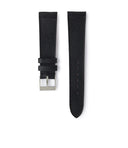
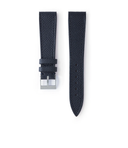
The case stands just 11mm tall. It’s three parts are marked by the rounded bezel and caseback that protrude slightly beyond the midcase. All parts wear even polishing. The double dimpled flat crown is robust and features the rope motif that is the brand’s signature. The lugs are short and curve down quite dramatically, reducing the overall footprint of the watch face to just 48.5mm. Their 20mm gap is furnished with quick release black, large-grained leather strap secured by a signed platinum pin buckle.
As noted earlier, the lever for the month complication is tidily integrated into the top right lug. It is machined precisely and housed in a recess so there is no risk of accidentally deploying it. The lever goes back into place with a reassuring click.
The movement
Visible through the display caseback is the Octa calibre 1300.3, crafted almost entirely from rose gold. The 18k bridges are decorated with circular striping while the uni- directional winding 22k gold rotor wears a barleycorn pattern interrupted only by the engraved brand mark, logo and motto. The edges of the bridges are bevelled and polished and the screw heads are black polished.
The calendar complication is entirely integrated into the 33mm-wide calibre, that stands just 5.2mm tall. It has a free-sprung balance wheel that beats at 21,600 vibrations per hour. The mainspring barrel offers up to 160 hours of reserve, but 120 of them are suited to chronometric standards.
The watch comes with its retail black label paperwork from 2016 as well as its full set of inner and outer boxes.
In context
The Black Label references have long been the preserve of a hand-selected group of seasoned F. P. Journe collectors. This represents a rarity even within this small group of Black Label pieces, as a reference whose aesthetic has been retired from the brand’s current offering.