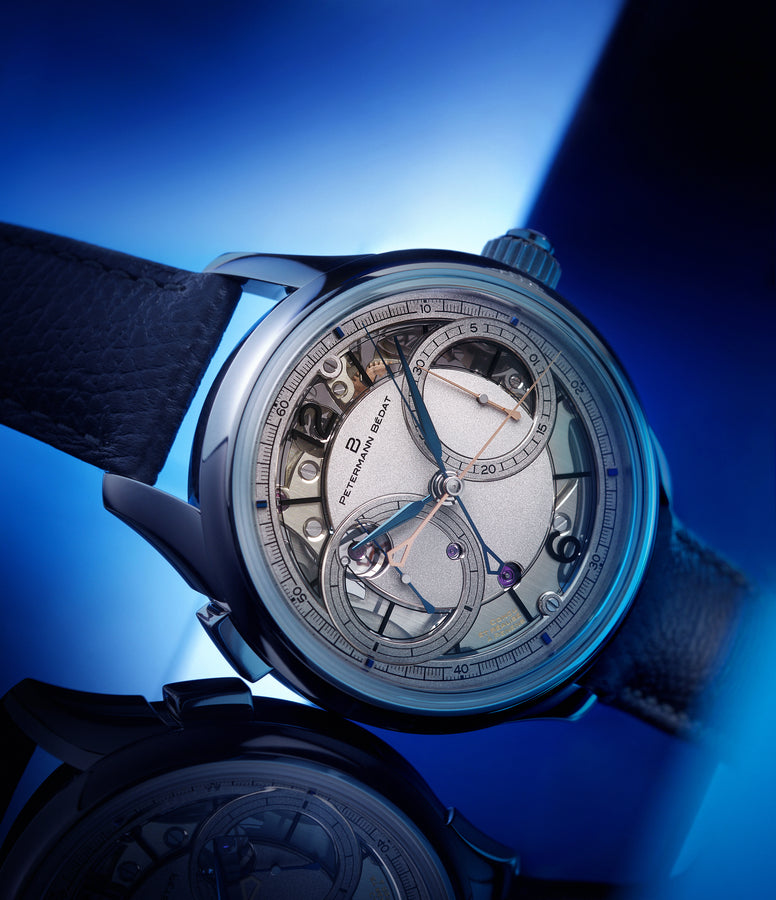
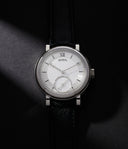
In 2011, De Bethune was awarded the Aiguille d’Or at the Grand Prix d’Horlogerie de Genève (GPHG) - a commendation that is awarded for the best overall watch in all categories - for the DB28. The "Kind of Blue" is a playful variation on the original piece, introducing a very different aesthetic with its completely electric blue appearance from case to dial to movement, and that can also be read as a tongue-in-cheek reference to the legendary Miles Davis album. This Kind of Blue Tourbillon merges the best of De Bethune's recent experiments in this line, combining several traits from previous iterations into a single piece. Only 20 examples were created, making this a rarely seen and fairly exclusive piece.
The independent watchmaker is best known for decidedly contemporary design innovations, which firmly push the boundaries of 21st century horology. In its quest, De Bethune continues to conduct research and development within the manufacture’s laboratory, embracing materials new to the watch industry. The Kind of Blue Tourbillon is a fitting demonstration of this, displaying a multitude of finishes, treatments, and materials that have become widely recognised for their use in timepieces from De Bethune.
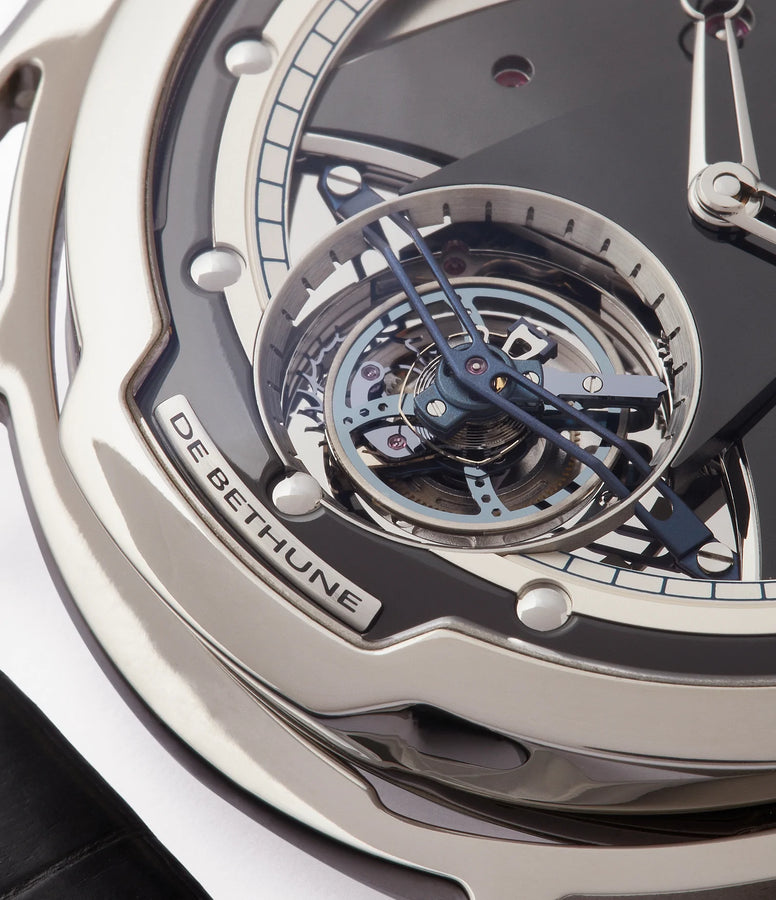
This DB28 Kind of Blue Tourbillon displays a blued-titanium bridge on the dial in De Bethune’s signature ‘triangle’ form, finished with a drawn/chamfered contour. In the centre lies a delicate Milky Way patterns produced by laser-beam micro-milling and gilded with 24-carat gold leaf. The skeletonised polished titanium hands, create depth and preserving legibility by contrasting against the blue aesthetic of the watch. The hours and minutes are delineated by circular dots which sit on the outer sector of the watch, with "60" at the top of the dial and "seconds" engraved below the tourbillon. This is a 30-second tourbillon, a complication that De Bethune is particularly associated with.
The DB 2009v5 calibre of this piece not only displays a very high level of finishing, with hand-decorated components, but is also technologically impressive - representing De Bethune’s unique combination of cutting-edge precision and 18th century tradition. The components display remarkable hand-finishing, with concentric graining and sharp, polished-bevels. With self-regulating twin barrels seen on the dial-side of the watch, a power-reserve of 120 hours (5 days) is achieved, shown by the power-reserve indicator on the reverse of the watch.
Separating this reference from the standard DB28, is De Bethune’s claim to the lightest tourbillon in watchmaking - weighing just 0.18 grams - fully-displayed on the dial side at 6 o’clock. Made from silicon and titanium, the tourbillon in the DB28 uses a balance spring and escape-wheel, with a blued titanium bridge. Making a full rotation every 30 seconds (rather than the more common 60), it is arguably the only high-beat tourbillon, oscillating at 36’000 bph.
By way of protection, the DB 2009v5 calibre also boasts a triple-parachute shock-absorbing system; unique to De Bethune calibres. The titanium bridge of the triple parachute is secured by a spring-based system, protecting the heart of the movement. The various architectural elements are connected by three jewels, thereby absorbing shocks and ensuring precise re-positioning of the bridge after displacement.
Sized at a contemporary 43 mm in diameter, the distinctive drum-shaped case of the DB28 is made from blued titanium, with an ultra-light profile. The manufacture's articulated, hollowed lugs are spring-loaded, neatly forming around the wrist. The entire watch is given this same high-polish blued finish, while the screw-down crown is located at the 12 o’clock position.