











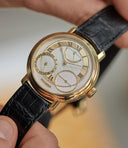
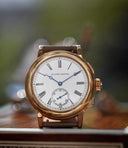










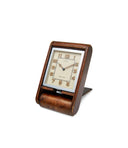
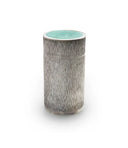
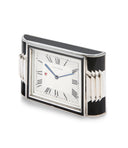


This is an example of the Audemars Piguet Jules Audemars Grande Sonnerie reference 25750BA* in yellow gold. It was one of two references which the brand announced and created between 1994 and 1995, and they were the first serially produced grande sonnerie wristwatches ever made. The 25750BA was produced in a limited series of 50 examples. It features a three-position chiming function, as well as a pusher to engage the quarter repeater complication on-demand. It is powered by the manually wound calibre 2868 developed by Renaud et Papi.
Renaud et Papi
High-end watchmaking in the 21st century has a common denominator – a Swiss movement manufacture which nowadays goes by the name of Audemars Piguet Le Locle, but you may know them better as Renaud et Papi.
An impressive host of talent, working at the very upper echelons of watchmaking, started their careers at the firm before setting out on their own, from the Grönefeld brothers to Stephen Forsey. Over the span of its lifetime, the specialised manufacture has essentially become a training ground for horology’s finest, with a disproportionate impact considering its small size. In many ways, working from the shadows, they are also behind many of modern watchmaking’s success stories. Richard Mille didn’t come up with everything on his own, after all.
The roots of the company took hold way back in 1984, when two ambitious young watchmakers, Dominique Renaud and Giulio Papi, met whilst working at Audemars Piguet. There, they discovered that they both shared a dream of working in the field of grand complications.


Impetuous and imbued with the kind of bravado only found in the young and hungry, they decided to set out on their own, founding the eponymous Renaud & Papi SA in Le Locle in 1986, rather than spending years or even decades working their way up through the traditional system.
Their timing proved uncanny as an interest in the kind of high watchmaking they sought to focus on was beginning to resurface, while many of the watch companies that had survived the ‘70s lacked the expertise or the manpower to produce such watches, instead forcing them to turn to third parties. Though it was talent that would carry them through, the aftermath of the Quartz Crisis created opportunities for the two young men, which they were certain to capitalise on. Whereas it may have been a race to the bottom for some, it was certainly the reverse for Renaud and Papi.