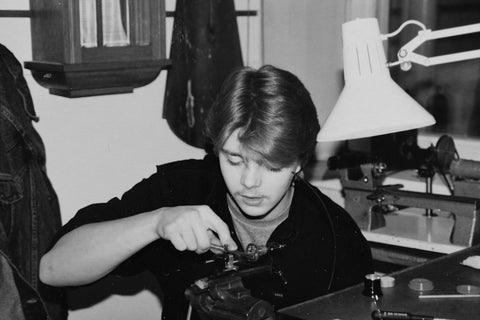
Kari Voutilainen followed the tried-and-true path for modern independent makers – learning his craft at the restoration house of Michel Parmigiani after graduating from watchmaking school – before taking on a teaching role at the Watchmakers of Switzerland Training and Educational Program. His next step to was to establish himself as an independent watchmaker, something he has managed to do with a degree of success seldom seen in this segment of the market.
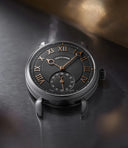
First produced in 2011, the Vingt-8 has gone on to become the backbone of the Finnish watchmaker’s catalogue of offerings. This variant, the Vingt-8 ISO, features quite a different approach to time-telling that is based on the work of Nobel laureate Daniel Kahneman. Taking the idea that our brains form two different ways of processing thoughts, we have System 1, the typical way that time is read, through the fixed position of numbers with hands of varying lengths indicating them. Through experience, we would only need a glance to read the time. However, the Vingt-8 ISO integrates System 2, a second way where the brain is forced to decipher an unfamiliar layout, thus casting the process of reading time in an entirely different light.
The effect is a much more meaningful, purposeful way of reading the time. Voutilainen has kept the lengths of the hour and minute hands - shorter and longer respectively. The hour hand is used to indicate the hours, but the minute hand goes through a more complex change that might seem confusing at first, but can be easily deciphered according to relative position. At the top of the hour, the hour and minute hands overlap, while at every half hour, the hands are directly opposite each other. The chapter ring is a crucial player here, displaying a printed chapter of 5-minute intervals. This rotates over the course of an hour, working to allow the hands to meet at exactly every hour.
The watch's 39mm case is forged from platinum and features a three-part case construction. The bezel and mid case wear rounded profiles. The bezel around the display caseback is flatter, with a groove around the well-proportioned crown to make it easier to engage it to set the time. All parts are evenly high-polished.
The Calibre 28 typically found within the Vingt-8 has been modified slightly to accommodate the new method of telling time, but remains visually very similar. Developed entirely in-house, the movement is still regulated by the double-wheel escapement, another Voutilainen calling card. It features a free-sprung balance with Breguet overcoil, a Grossmann interior curve, and direct impulse escapement with two large escapement wheels. Not only is it highly engineered, it is also beautifully hand-finished. The plates wear côtes de Geneve decorating, while the visible wheels wear a range of finishes – from black polished to radial brushed. The edges of the bridges feature anglage and the balance is beautifully black polished. The calibre is multi-layered in its arrangement, something that gives it visual depth. Screwed on plaques wear the brand mark as well as the serial number.
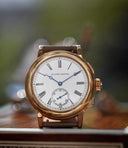
The blue dial, built on a base of sterling silver, features a range of patterns of guilloche, all machine turned by hand. The hour markers, both of the Arabic numeral and baton variety, are applied on a ring of a hobnail pattern. Outside it sits the rotating satiné circulaire chapter, with 5-minute intervals printed in white. The centre of the dial wears an intricate guilloché pattern. The subsidiary seconds register has a hobnail pattern guilloché in the centre. Mirroring the layout of the dial, the seconds register also features a satiné circulaire chapter of printed numerals.
The hands, true to the Voutilainen aesthetic, are of the observatoire variety. They feature a high contrast, frosted silver finish, with heat-blued inserts in the hours and minutes hands. The seconds hand is a simple baton with a prominent circular counter weight. These blend in excellently with the overall aesthetic of the piece.