F. P. Journe unsuccessfully attempted to deploy the phenomenon of resonance – first observed by Christiaan Huygens, Antide Janvier and Abraham-Louis Breguet – in a pocket watch in 1983. It is rooted in the idea that during the normal functioning of a balance and escapement, a certain amount of energy is lost. By placing another balance and escapement in close proximity, with the two setups beating in opposite directions, the dissipating energy would cause both to acoustically influence each other, and eventually they would sync and beat at the same rate. While the phenomenon was first identified by Dutch mathematician Christiaan Huygens in 1665, later researched and developed by Antide Janvier, and refined by Abraham-Louis Breguet, Journe was the first to term this acoustic coupling resonance.
He was also able to hone the phenomenon and bring it to the wristwatch some fifteen years after his initial attempt, with the prototypes displayed at his first Basel Fair in 1999. Ever since, the reference has come to stand and gained a cult following among collectors.
In around 2004, the brand retired the brass movements that marked its earliest years in favour of those crafted from 18 carat gold. This was also true of the Chronomètre à Résonance, with the brass calibre 1499 giving way to the solid gold version designated calibre 1499.2. These were fitted to the updated reference Resonance Nouveau (RN).
The RN used two movements – the calibre 1499.2 would give way to the 1499.3 (with improved power-reserve). The 1499.2 is understood to have been made for a brief period around 2005 to 2006. As a result, examples powered by the calibre 1499.2 are more of a rarity than even the first generation, brass-movement pieces.
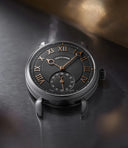
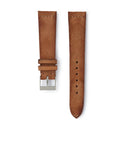
This example, which retailed in 2005 in Japan, is replete with the brand’s signature details. It features the elegant case, measuring 40mm across and standing 8.9mm tall. It is crafted from platinum. The rounded bezel meets the flat midcase in a small lip, with this detail also marking the edge of the display caseback. The short, turned down lugs, equal in width to the midcase, flow organically from it. The lugs are 20mm apart and are fitted with a large-grained black leather strap secured by a signed platinum pin buckle.
The slim crown integrated in the case between the top lugs helps set both time displays, while the more pronounced crown at 4 o’clock is designed to wind the movement. Pulling out this crown also helps reset and synchronise the twin seconds indicators. This is the most visible way of enforcing resonance – on their own the two balances sync up more gradually.
The caseback features deep engravings detailing the brand mark and motto, serial number and the precious metal it is crafted from. Worth noting are the Elinor and French as well as Swiss hallmarks on the case. These are indicators of this example’s early provenance. The erstwhile French casemaker Elinor worked extensively with F. P. Journe, with the brand later acquiring the foundry.
The lustrous white gold dial hosts two silver time displays that mirror each other’s form. They are framed by high polished stainless-steel with the time displays coated white. They are pad printed with Arabic minutes and hours chapters in the brand’s signature font. Both chapters also feature subsidiary seconds registers. The centre of the time display is adorned with clous de Paris patterns. The displays can be independently set to display the time in two zones around the world. At 12 o’clock lies a marine chronometre-style power reserve indicator counting down 40 hours since the mainspring was fully wound.
The time displays and the power reserve hands are of the brand’s signature biomorphic variety and heat blued. They provide a hint of vibrance to an otherwise restrained dial-side appearance.
The display caseback flaunts the manually wound calibre 1499.2. It is crafted from 18k rose gold, with horizontal striping and edges adorned with anglage. The baseplate is decorated with perlage. The movement features 36 pivot jewels for the twin gear train. It has a straight-line lever escapement, monometallic four-arm balance with four timing weights, self-compensating free-sprung flat balance spring oscillating at a rate of 21,600 vibrations per hour.
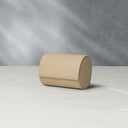
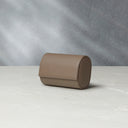
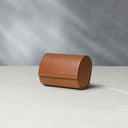
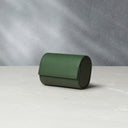
This Résonance Nouveau comes with its full set of box, retail and warranty paperwork from Japan-based retailer Kamine.
The Chronomètre à Résonance is perhaps the most consequential watch F. P. Journe has produced. It wears the weight of the history that informs it lightly, fitting it in proportions suited to contemporary preferences. The Résonance Nouveau follows in this trajectory, both in its proportions and the updated solid gold calibre 1499.2. The limited production period of this particular item is also a collectible detail.