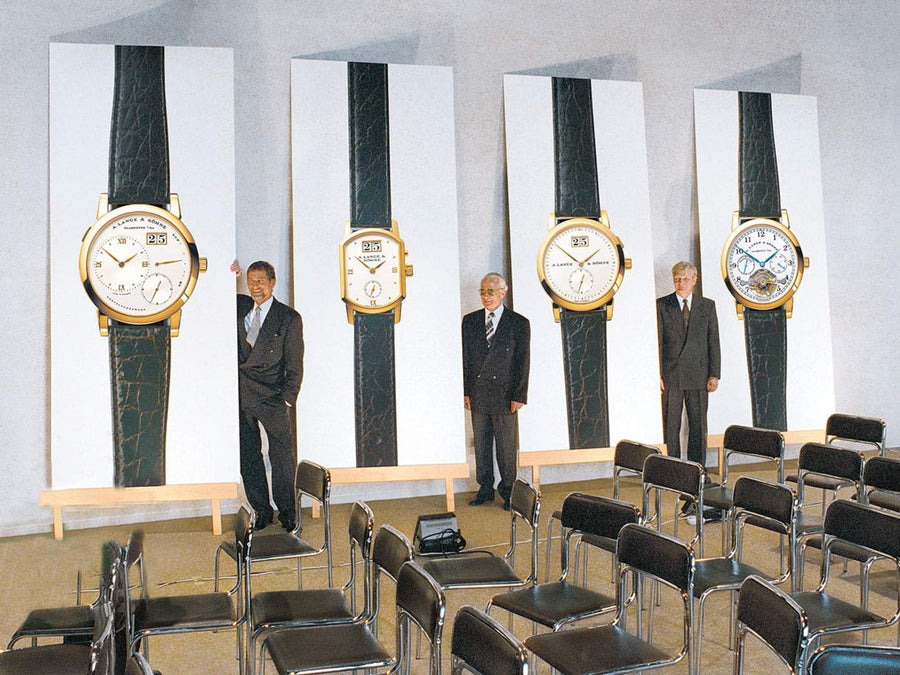
When A. Lange & Söhne was resurrected by Walter Lange (great grandson of founder Ferdinand Adolph Lange) and Günter Blümlein (who had previously overseen the resurgence of IWC and Jaeger-LeCoultre), they did so with four lines – Arkade, Saxonia, Tourbillon Pour le Mérite and the Lange 1. While each bore a distinct design language, the Lange 1 has come to be viewed as the quintessence of A. Lange & Söhne and the purest expression of Glashütte watchmaking.
Elemental to this is the decentralised display. Drawing lines from the centre of each display – the time, subsidiary seconds and the date – would result in an isosceles triangle. The layout is an inspired work of industrial design, revealing a deep understanding not just of proportional use of space but also how the wearer will interact with the watch face.
The Glashütte house introduced the Soirée with the references 110.029 and the 160.029 in 2001 – both featured white gold cases paired with mother of pearl dials, while the latter reference also featured an integrated white gold bracelet. This later expanded to include four other references in white gold, rose gold and platinum, as well as a limited edition of 25 examples for Paris-based retailer Dubail (reference 110.049).
However, just two references featured guilloché-adorned mother-of-pearl dials – the elusive pink gold reference 110.031 and the white gold reference 110.030.
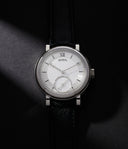
This is an example of the latter reference. The iridescence of the mother-of-pearl, alternatingly accentuated and tempered by the ripples of engine turning, is balanced by the cool, understated white gold case.
Mother of pearl is exceedingly delicate. The shells are carefully selected, polished, and cut before they go through the brand’s finishing and assembly process. Owing to it being naturally occurring, no two shells employed on these dials have the exact same pattern. The delicacy required of the process of engine turning such a material cannot be overstated. This thin mother-of-pearl dial is placed atop a solid silver dial.
This additional dial thickness is responsible for the marginally taller case – while it retains the 38.5mm diameter of the Lange 1, it stands marginally 10.5mm high (up from the 9.8mm height of the standard case).
However, it retains the structure and essence of the Lange 1. Crafted from white gold, the case features three parts. The rounded bezel is polished with a flat facet where it meets the horizontally satinated midcase. The rim of the exhibition case wears circular satination. The caseback wears facets that are polished. The lugs, soldered onto the midcase, are marginally stepped. They have a bevelled facet, and curve down dramatically. They are 20mm apart and are furnished with a fine grained navy leather strap secured with a signed, white gold pin buckle. The pusher at 10 o'clock quick sets the date.
The caseback rim features engravings detailing the brand mark, the serial number and the place of origin.
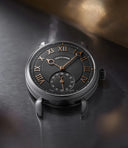
The dial wears black printing for all scales as well as lettering detailing the brand mark, place of origin and the twin barrel feature of the movement. The time display, set roseate-style engine turned backdrop, features an applied quarter Roman chapter of hours with diamond indices for the rest. The slightly overlapping subsidiary seconds register, also adorned with roseate engine turning, wears baton-style printed markers. Both registers, as well as the up-down power reserve indicator, are plied by the brand’s signature alpha-style hands. All parts of the dial, save for the chapters, scales and brand markings, are covered in roseate engine turning as if emanating from the cannon pinion. The large, framed twin window date display is achieved with high-contrast black Arabic numerals.
The Soirée edition watches feature the manually wound calibre L901.4. It is different from the calibre L901.0 typical of the Lange 1 by virtue of the elongated pinions required to traverse the additional thickness of the dial. That being said, the L901.4 is typical A. Lange & Söhne fare – it is marked by a large three-quarter German silver plate and a balance bridge lavished with free-hand engraving. The stainless-steel tip of the escape bridge and the swan neck regulator are black polished. The large bridge is adorned with striping with the brand mark, serial number and the number of positions it is adjusted to (five) engraved in gold. The wheels of the two barrels and those of the going train pivot on jewels ensconced in gold chatons. All visible screws are heat blued. The watch has a lever escapement, and the balance beats at 21,600 A/h. When fully wound, the twin mainspring barrels offer 72 hours of autonomy.
It represents a high-craft reimagining of one of the most iconic and versatile modern wristwatch designs. The engine-turned mother-of-pearl dial, iridescent one moment and restrained the next, is paired optimally with a white precious metal and an ergonomically refined case. The balance of flamboyance and practicality is perfectly poised, making this one of the most desired iterations of the Lange 1.