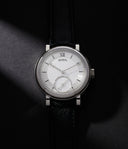
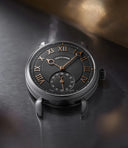
The reference 5070 owes its mid-century dimensions and charm to the 46mm-wide reference 2512, a unique split-second chronograph Patek Philippe created in the early 1950s. The 5070 was the brand’s first production piece to feature a case that was larger than 40 mm. Originally released in 1998, it was also the first chronograph since the Reference 1463 to not feature a calendar complication. It was one of the very last to feature the calibre CH 27-70, based on the Lemania 2310 ébauche.
This example is part of the modern renaissance for the Reference 5070, which began in 2015. This is perhaps best characterised by the Saatchi Edition pieces that were showcased at the eponymous gallery, and a very select few created to supplement this release. The dial is the main point of difference here, as it has a slightly lighter navy blue tone compared to the deeper shade on older and modern pieces. Additionally, it has a combination of dot indications and a single Roman numeral at 12 o'clock, as opposed to the fully numeral indices across other Reference 5070 pieces. Notably, the watch also has the -012 designation, as opposed to the Saatchi -013 or original release -01.
The reference was originally produced exclusively in yellow gold with a black dial (between 1998-2002), before being offered in white gold with a silvered dial (between 2002 and 2006), followed by a pink gold case and silvered dial (between 2003 and 2007). It is worth noting these configurations since the 5070 represents one of the last references from an era where the brand followed a more disciplined approach to pairing case metal and dial in its standard production watches.
The 42mm platinum case is replete with cues from the Reference 2512. It features a double-stepped bezel, with a gently cambered part giving way to a raised portion that meets the slightly domed crystal; this form is echoed on the simple, screwed-on display caseback. These stepped details serve to lighten the 11.6mm case height. The subtly rounded midcase is home to square chronograph pushers. The lugs feature a sharp stepped facet that is as faithful to classicality as it is visually consistent with the form of the bezel and caseback – they curve down sharply, terminating in flat ends that are well suited to wrist ergonomics. Engravings detailing the brand mark and precious metal hallmarks are reserved for the underside of the lugs.
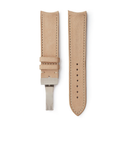
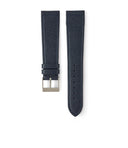
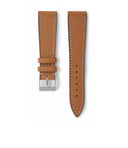
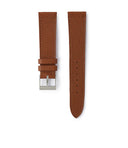
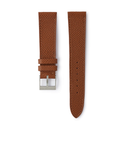
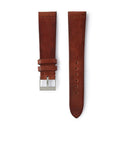
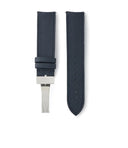
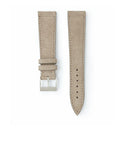
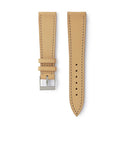
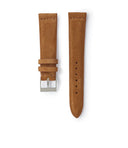
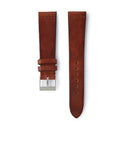
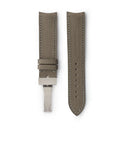
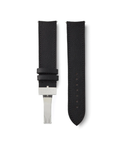
The 20mm wide lugs are furnished with a fresh wide-grained blue leather strap secured by a platinum deployant clasp with the Calatrava cross. As is customary for watches in this metal from this era of Patek Philippe, a brilliant cut Top Wesselton diamond is set into the midcase between the bottom lugs.
The dial layout faithfully follows the double register layout of storied chronographs from Patek Philippe’s past catalogue. The tachymeter scale is printed in bright white for maximum visibility against the sea of sunburst blue. Following this is a chapter of applied dot indices, except for the Roman numeral at 12 o'clock. The subsidiary registers – one with running seconds and the other registering 30 minutes of elapsed time – feature chemin de fer scales with Arabic numerals. Their circular engine turning gives their blue shade a sunburst quality that makes them stand out from the solid shade of the rest of the dial. The leaf-style white gold hours and minutes hands are finely curved and finished. The central chronograph seconds hand features a wide counterbalance that progressively narrows to a fine tip for precise reading on the tachymeter scale.
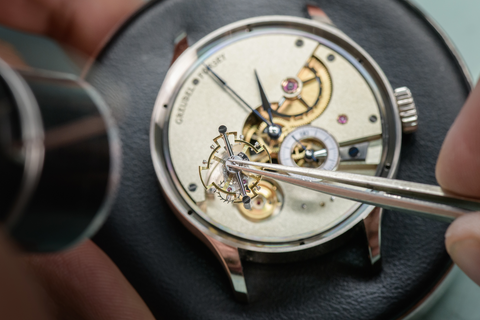
Exhibited through the caseback is the manually wound calibre CH 27-70, based on the legendary Lemania calibre 2310 ébauche. Mechanically robust, the movement is also decorated to the standard required for the Geneve seal, which this example bears. This, of course, also helps date the new-old-stock movement since the brand transitioned to the Patek Philippe seal after 2009. The bridges feature Côtes de Genève with the bevelled edges wearing mirrored anglage. The countersinks for the jewels and screws are also mirror polished. The movement uses a monometallic Gyromax balance wheel that beats at 18,000 A/h interacting with a straight-line lever escapement. The single barrel offers 60 hours of reserve when fully wound.
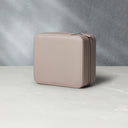
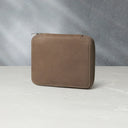
The reference 5070 is a watch that lives in its details, and this example preserves every crisp last one of them. It comes with a full set, which includes all paperwork and boxes, as well as the original paper packaging new watches come to the retailer in. Crucially, the boxes and paperwork wear matching serial numbers.