Founded in 2001 in Dresden, Saxony the independent house of Lang & Heyne was helmed by Marco Lang, after Mirko Heyne left the following year to work at Nomos in nearby Glashütte. Lang, a fifth-generation watchmaker, who had got his start in precision mechanics, built the brand around the baroque spirit of Dresden, imbuing the technical finesse of the masters whose historic clocks and watches he had watched his father restore for the Dresden Art Chamber. He too would earn his stripes in restoration before crafting watches under his own name. Lang & Heyne exhibited its first watches, the Friedrich August and the Johann, when the brand exhibited with the Academy of Independent Watchmakers (AHCI) at Baselworld in 2002. It continued the tradition of naming its watches after nobility and those who made meaningful contributions to Saxon society even after Lang left the brand in 2019.
As a whole, Lang & Heyne's watches are remarkably well thought out and spoken of highly by fellow watchmakers for their technical detail, movement construction and finishing. This example is one of a limited series of seven, made for the Asia-based retailer Sincere Watches, in celebration of their Platinum Jubilee, or 70th year, anniversary in 2024.
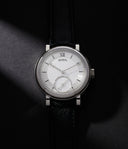
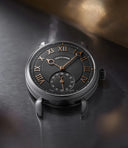
The dial of this Friedrich III Remontoir is constructed from white ceramic, and has a slightly sunken section where the sub-dial is placed, giving it a sense of depth. The indices and other indications are engraved and filled with printing ink before being polished. In place of the typical 12 o'clock indication, we see the Lang & Heyne brand mark, and "Made in Saxony" is printed just below the sub-dial. The centre of the dial features a givré finish — this is a densely packed, softly shimmering texture that is achieved by sandblasting a brass plate that has been galvanised to a shade of royal blue. Meanwhile, the hours and minutes hands are cathedral-style, while the seconds indicator is a simple pointer with a cathedral-style counterweight.
This example features the 39.2mm case in white gold. The rounded, polished bezel meets the flat profile of the midcase in a lip. The rim of the exhibition caseback, which has a flatter form than the bezel, also meets the midcase in a lip. The caseback is affixed by screws. The brand’s signature triple lugs originate from the midcase. An unusual choice, their commitment to this design choice makes them distinct, working towards a vision of watchmaking that is not necessarily driven by audience desires, and maintaining a sense of their individual style.
Seen through the sapphire caseback, the Calibre VI-I features a deep golden hue across its baseplate and bridges. In Glashütte tradition, the stainless steel balance bridge wears intricate hand engraving. It is topped with a swan-neck regulator that is black polished. The balance wheel pivots on a brilliant cut diamond – another detail traditional to Glashütte makers.
The balance wheel interacts with the escapement that is topped with the one-second constant force mechanism governed by a Reuleaux triangle. This remontoir ensures a constant force on the balance, producing a stable amplitude and resulting in better chronometry. The calibre derives 42 hours of autonomy from a single barrel.
Aside from the finishing refinements already mentioned, the jewels on which the wheels of the going train pivot feature gold chatons, while all screws are heat blued. Notably, the screws fixing the bridge in place also feature detailed countersinks. The tip of the escape bridge as well as the components of the remontoir are black polished. The brand mark as well as the words ‘One of 7' are free hand engraved on to the baseplate. A subtle touch is the light imprint of the Sincere logo printed on the sapphire glass, still allowing the details of the movement to shine through.
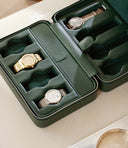
The watch comes with its full set of box and paperwork.