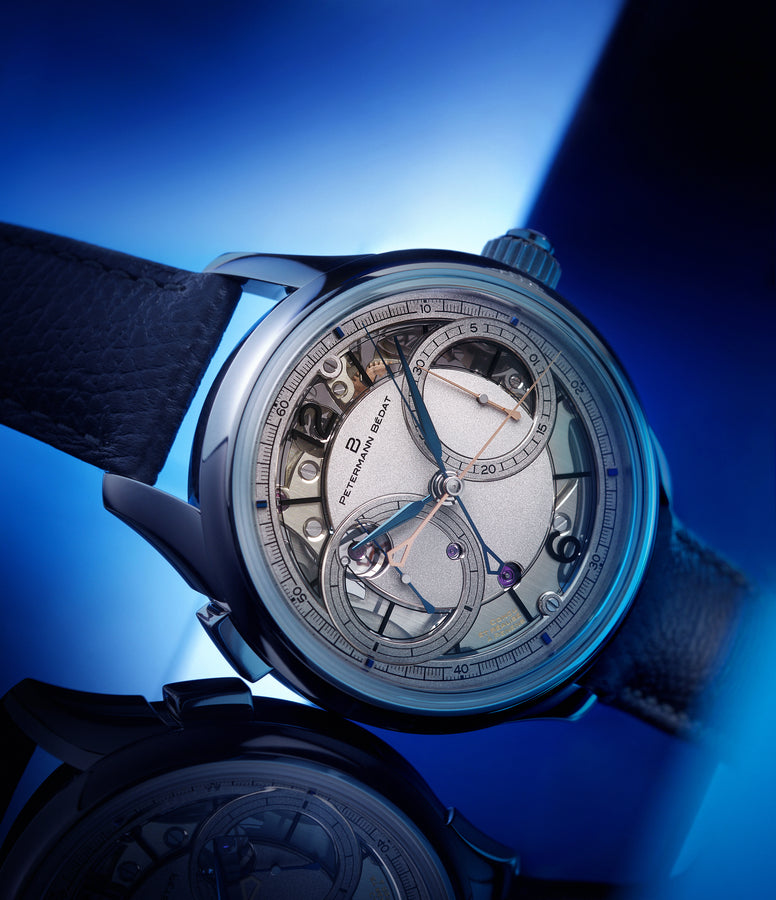
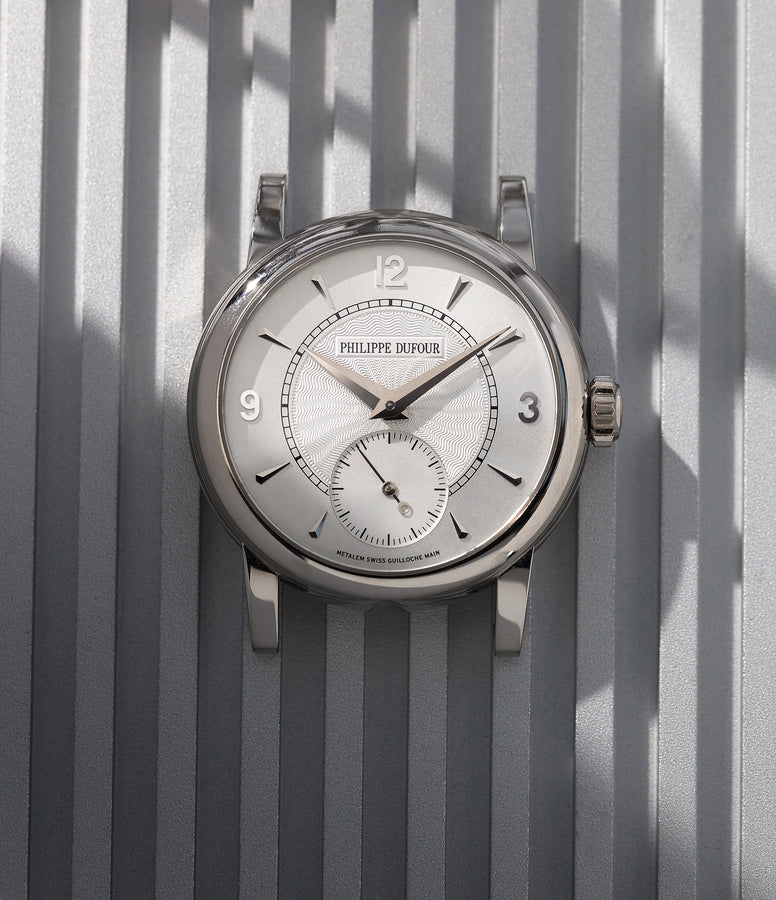
Introduced in 2005, the H2 Tourbillon Resonance marked a truly novel approach to the concept of resonance in watchmaking. Where the H1 pushed boundaries in its design layout and approach to the tourbillon, the H2 takes things one step further, combining it with the concept of resonance. Furthermore, the H2's design language and aesthetics continue Haldimann's subscription to the philosophies of Glashütte watchmaker Carl Moritz Grossmann, rooted in the idea of pursuing mechanical innovation while staying within the parameters of elegant design.
Resonance is a very rarely seen and used phenomenon in watchmaking, and in recent years, appears to largely be the preserve of independent watchmakers. Some recognisable names include F. P. Journe's Chronomètre à Résonance, the Armin Strom Mirrored Force Resonance, and Vianney Halter's Deep Space Resonance. The H2 Tourbillon Resonance is thus part of a highly complicated and elusive group of watches, all trying to harness the effects of vibration, oscillation, and synchronised balances to advance the work of historical watchmakers such as Abraham-Louis Breguet and Antide Janvier.
Briefly put, resonance is used in watchmaking to increase the accuracy of a watch or a clock. The vibrations of one component create a sympathetic response with another component resulting in a mirrored frequency. Through the mutual exchange of energy, they reach an equilibrium that reduces the possibility of typical accuracy errors. A highly metaphysical concept, resonance is also challenging to implement because of the accuracy requirements — each regulator must be adjusted as closely as possible to each other, and as F. P. Journe discovered, only a difference of 5 seconds per day can be tolerated, leaving an extremely small margin of error.
On the H2, we see that the watch has two resonating balances, each with their own escapements, which are fixed on a base flying tourbillon. These are connected by a single coupling spring, which transfers energy between them. A single gear train drives the tourbillon. The effect is a mesmerising rotation of both balances around the dial, in perfectly synchronised orbit.
There are several inheritances between the H2 and its predecessor, the H1. Most evident is the shape of the twin balances, which have doubled in this instance and the flying tourbillon itself. The latter was inspired by the work of Alfred Helwig, a German watchmaker who invented the flying tourbillon, and has become a key visual element of Haldimann's work. The handcraft is also an incredible aspect of the watch, as Haldimann famously forgoes almost all modern conveniences in favour of traditional tools and techniques for much of his manufacturing. When examined closely, it becomes clear that each aspect of the watch has been done to the absolute highest standards possible by hand, making this a truly impressive piece of work.
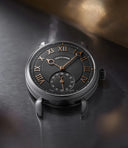
Some examples of the H2 feature more typical Breguet-style hands, but this particular piece makes use of Haldimann's signature spade-shaped hands. These are delicately outlined and match the slender shape of the numerals in a way that is very pleasingly coherent. The hands themselves are arranged on separate rings around the tourbillon, with the shorter hand indicating the hour and the longer hand indicating the minutes.
The 39mm platinum case on this example features a three-part construction, with a pronounced bezel and caseback sandwiching a concave midcase. All parts wear an even polished appearance. At 3 o'clock is a well-proportioned onion crown. The lugs, originating from the midcase, are straight, with a gentle curvature to them.
The exhibition caseback reveals the in-house manual wound calibre H-Zen, also known as the Zen-H2 — it's not surprising to see a slight variation in the way that the calibre is referred to across examples, as even today the watchmaker is continually making minute adjustments to improve the movement. The movement itself is fairly minimal in appearance, maintaining the layout that the H1 introduced. It wears a frosted plate with three visible spring barrels – two of them interact through gear trains with the pinion on which the tourbillon is mounted while the third governs the functioning of the annular hour and minute hands, with a complex gear train. Aside from the working rubies, the plate features an embossed brand logo with fine, precise engravings detailing the brand name, calibre and serial numbers.