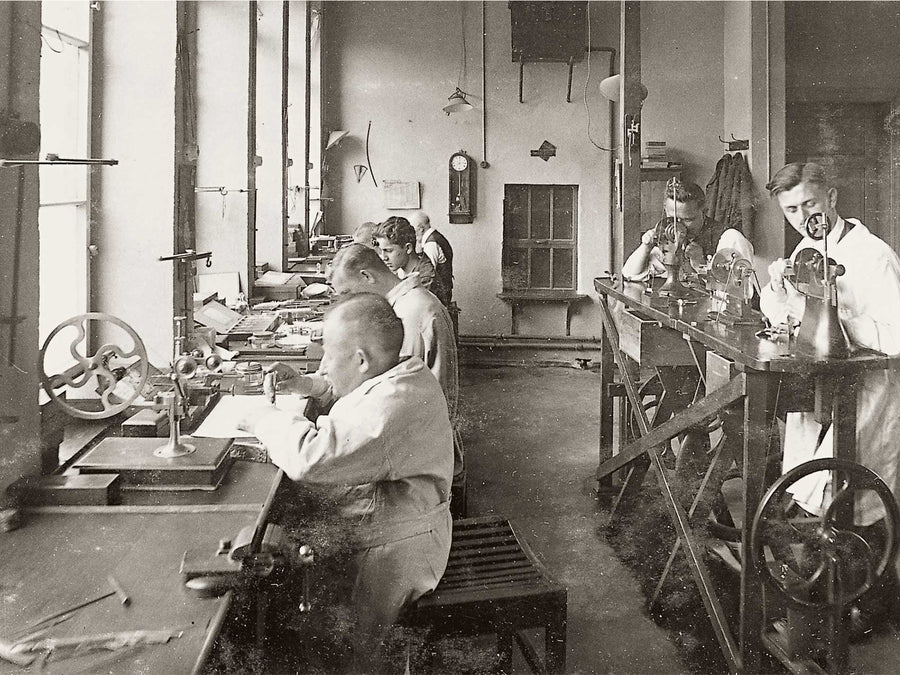
The name Lange has been tied to watchmaking and the Saxony area of Germany for centuries. In the 1800s, Ferdinand Adolph Lange, which is where the “A” in A. Lange & Söhne comes from – began his watchmaking journey under the tutelage of master watchmaker Johann Christian Friedrich Gutkaes. Passed from father to son, the Lange name flourished, before encountering considerable obstacles during the 20th century.
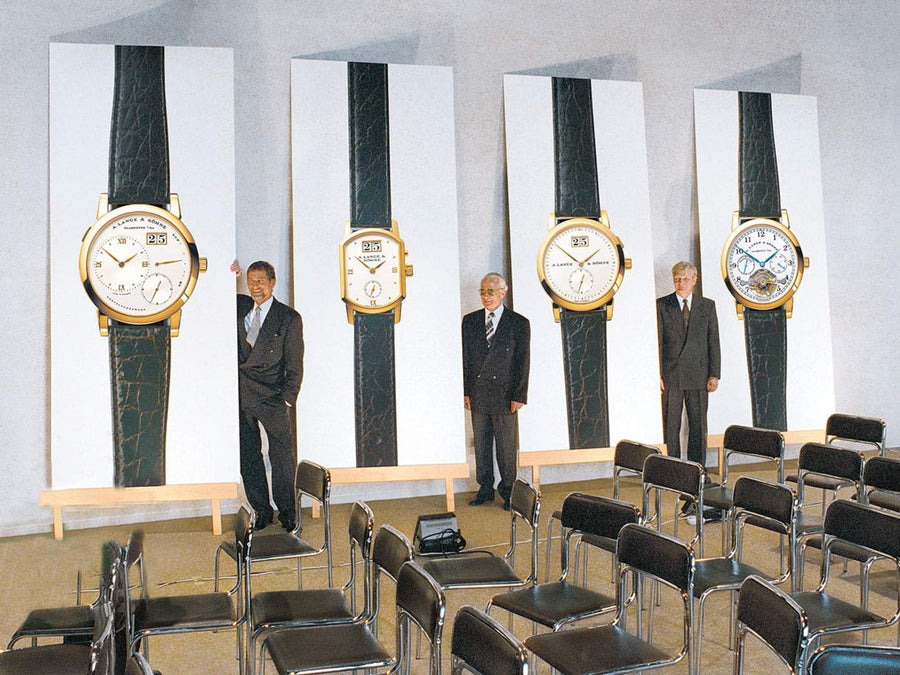
In 1990, the brand was revived by the great-grandson of Ferdinand Adolph Lange, Walter, and watch industry veteran, Günter Blümlein. A Nuremberg native, Blümlein grew up in post-War Germany, had previously overseen the resurgence of IWC and Jaeger-LeCoultre. This started the four-year journey that Lange and Blümlein would go on with their small team to bring the company back from the ashes, with the release of their first four models on October 25, 1994. Today, the Lange 1 is one of the most distinctive watches in modern consciousness.
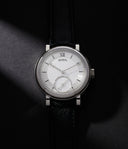
This Lange 1 ref. 101.325X is an especially early example with several intriguing features that depart from other examples with integrated bracelets. Typically, Lange pieces with bracelets have two configurations: either with an unremovable integrated bracelet connected to the watch without lugs, or the watch possesses lugs, and the accompanying bracelet is removable. With this example, while the watch features lugs, the bracelet is directly connected to the watch and cannot be removed, combining both options. This is a rare iteration, with only a very small number of watches produced in this configuration, as the brand later moved to create the removable bracelet options mentioned above.
Some of the features that further highlight the fact that the piece is a very early example include the fact that it has a small “Made in Germany” line of text printed below the sub-dial in a sans-serif font with a more condensed format. Later examples are printed in ‘Engravers MT’, a serif font, which has noticeably thicker lettering compared to the font found on this piece, while the text is more spread out. Further subtle differences can be found in the fact that the umlaut above the “ü” in “Glashütte” is slightly separate from the letter itself or that the “I” in “I/SA” (“In Sachsen” - “in Saxony”) sits above the halfway point of the slash. Additionally, the "X" designation on the reference is an interesting detail that simply indicates that the watch came with an integrated bracelet, rather than the detachable metal bracelet that usually accompanied others in the reference.
More generally speaking, this Lange 1 reference 101.325X bears most of the classic styling that would later come to define the series, such as the asymmetric dial design and carefully designed date windows, which were inspired by the Five-Minute Clock at Semper Opera House in Dresden. The proportions of the watch have been carefully calculated according to the Golden Ratio, creating an instantly recognisable layout.
The piece is powered by the calibre L901.0, based on a Jaeger-LeCoultre caliber 822 gear train that Günter Blümlein brought over. Visible through the open caseback, the aesthetics of the movement are just as impressive as the mechanics, with chamfering and interior angles superbly hand-finished. Moreover, it features an artistic flourish, a balance-cock engraved by one of Lange’s master engravers. In fact, each individual watchmaker's unique engraving style can be identified as a result. The bridges and plates are made from German silver, an alloy of copper, nickel, and zinc, with a warm silver tone that will develop a subtle patina over time.
The watch is accompanied by a signed and stamped certificate of origin.